Area formulas become much easier to use once the dimensions are defined correctly. For a trapezoid, measure the perpendicular distance between the parallel bases, not the sloping side. For a regular polygon, the apothem runs from the centre to the midpoint of a side at a right angle. The formulas below cover the common shop-layout cases: a trapezoid, a regular hexagon, and a regular octagon.
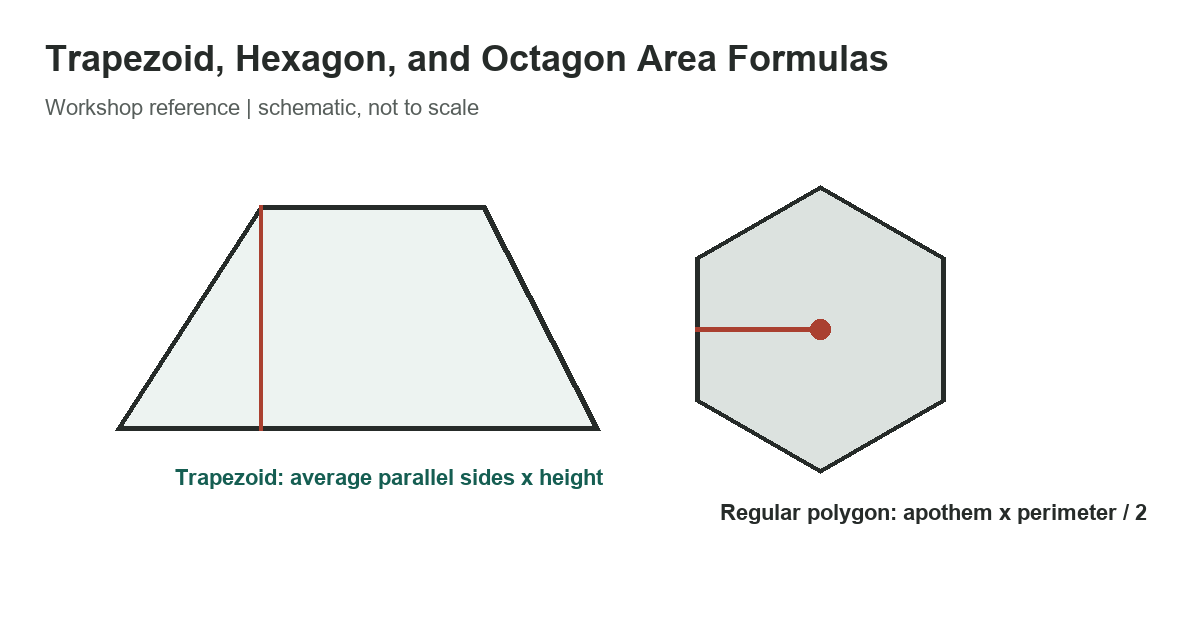
Quick formula reference
Use consistent units throughout. If every length is in inches, the calculated area is in square inches; if lengths are in millimetres, the area is in square millimetres. The regular-polygon formula applies only when all sides and angles are equal. A shape that merely looks hexagonal or octagonal should be checked before using it as a regular polygon.
[gs_table id=”10781″]
Trapezoid area
In US usage, a trapezoid has one pair of parallel sides. Call their lengths b1 and b2, and call the perpendicular separation h. Its area is the average of the two parallel-side lengths multiplied by the height: A = (b1 + b2)h/2. For example, bases of 8 and 14 units with a perpendicular height of 5 give (8 + 14) x 5 / 2 = 55 square units. The nonparallel sides do not enter this calculation directly.
Do not substitute the sloping-edge length for h. If only an angled edge is measurable, obtain the vertical component from the drawing or coordinates. A height error directly scales the calculated area. Also check the regional naming convention: UK mathematical usage commonly calls this shape a trapezium and uses trapezoid for a quadrilateral with no parallel sides. The drawing and definition matter more than the name on an old chart.
Regular hexagon and octagon
For any regular polygon, area is one-half the apothem times the perimeter: A = ap/2. The apothem is not the radius from the centre to a vertex. If the side length is s and the polygon has n sides, perimeter p = ns. The apothem can be measured from a reliable drawing or calculated from the side length and polygon geometry. For a regular hexagon, a = (sqrt(3)/2)s, so area is (3sqrt(3)/2)s squared. With a 6-unit side, that is 54sqrt(3), approximately 93.53 square units.
For a regular octagon, a = s/(2tan(22.5 degrees)). Equivalently, its area is 2(1 + sqrt(2))s squared. A 4-unit side produces 32(1 + sqrt(2)), approximately 77.25 square units. Keep the exact radical where precision matters; rounded decimal values are useful for layout estimates but can accumulate error when dimensions are later reused.
When the shape is not regular
Do not apply the regular-polygon equation to an irregular six- or eight-sided outline. Divide the outline into triangles or trapezoids, calculate each piece from perpendicular dimensions, and add the areas. For a measured coordinate drawing, use the vertex coordinates with a suitable polygon-area method and verify that points are listed in boundary order. A self-crossing or incomplete outline can produce a misleading result.
For physical work, identify the datum, record whether dimensions are nominal or measured, and preserve the units in the calculation. Check whether openings, corner radii, bevels, or material allowances should be subtracted separately. These formulas calculate planar area; they do not include thickness, surface finish, stock allowance, or waste from cutting.
- Identify the parallel sides and perpendicular height for a trapezoid.
- Use apothem and perimeter only for a regular polygon.
- Keep units consistent and round only at the end.
- Split irregular outlines into simpler measured shapes.
For related shop references, browse the size-chart library, check the inch-to-millimetre reference, and review the bolt measurement chart.
Sources
OpenStax provides the area identities for trapezoids and regular polygons and worked regular-hexagon and octagon examples. The example values here are recalculated from the dimensions stated in this guide.