To turn a PE pipe bend multiplier into a usable layout, multiply the pipe’s actual outside diameter by the permitted factor. Then distinguish the resulting bend radius from the length of pipe following the curve. The factor depends on the pipe, dimension ratio, fittings, and installation conditions; polyethylene is not permission to make any bend that can be forced into place.
The examples here explain the arithmetic for water-line planning. They do not approve a particular pipe installation, trench, pulling operation, or pressure rating. Confirm the current pipe maker’s limits and the project requirements before selecting a route.
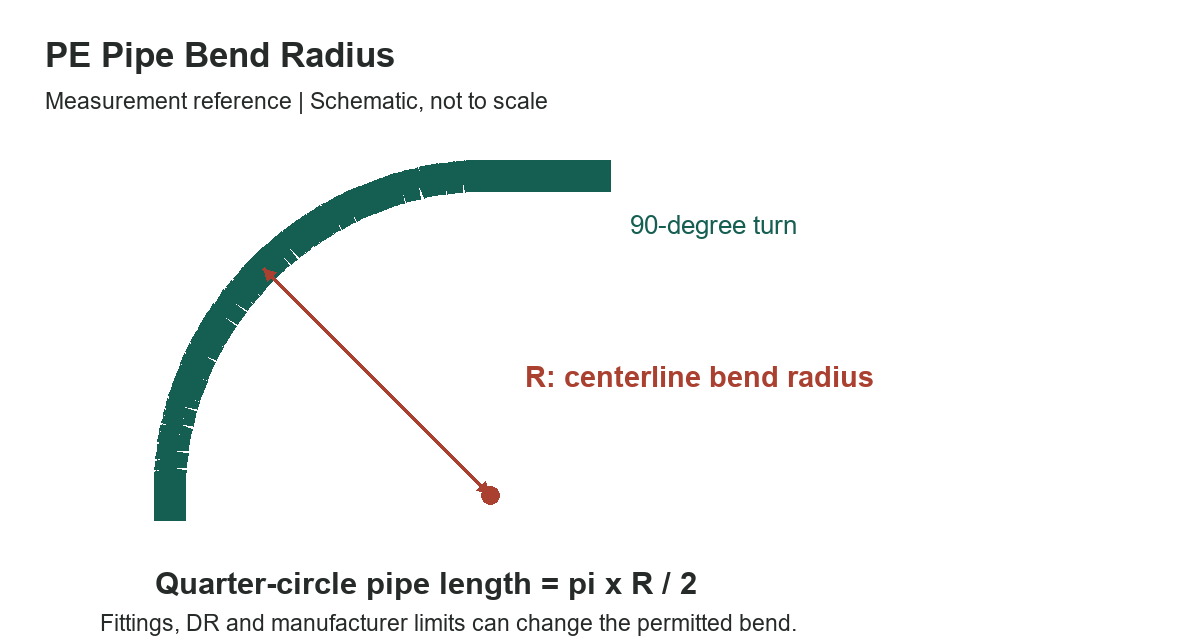
From outside diameter to bend radius
The Plastics Pipe Institute’s municipal water field manual gives a 27-times-outside-diameter example for the DR 17-21 open-trench context. The table below applies that factor to three illustrative measured diameters. These are arithmetic inputs, not a list of nominal pipe sizes available to purchase.
| 1.000 | 27.000 | 2.250 | 3.534 |
|---|---|---|---|
| 2.000 | 54.000 | 4.500 | 7.069 |
| 4.000 | 108.000 | 9.000 | 14.137 |
3 rows
Scroll horizontally to view all columns.
For an actual outside diameter of 2 inches, 27 times the diameter gives a 54-inch radius, or 4.5 feet. A 90-degree circular sweep at that radius uses approximately 7.069 feet of curved pipe. Straight approaches, fitting allowances, and the installation method add their own requirements.
Radius, diameter, and arc length answer different questions
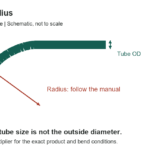
The radius runs from the center of the imaginary circle to the pipe centerline. The circle’s diameter is twice that radius. Neither dimension is the length of pipe around the bend. For a quarter circle, that curved length equals pi multiplied by the radius and divided by two.
A radius shown on a plan is therefore not a cut length. Mark the straight-to-curve transition points and include the straight runs separately. If the planned curve is not circular or does not turn through 90 degrees, use its actual geometry rather than borrowing the quarter-circle length unchanged.
Actual outside diameter is not the nominal size
Pipe size labels belong to particular dimensional systems. Read the product markings and dimensional documentation, then obtain the actual outside diameter needed for the calculation. Do not take the number before the word inch in a catalog and automatically use it as the measured OD.
Dimension ratio also matters. For an OD-controlled pipe, it relates outside diameter to wall thickness. A bend factor associated with one DR range should not be transferred to an unidentified pipe. If the markings are missing or ambiguous, resolve the pipe identity before treating any calculated sweep as acceptable.
A fitting inside the bend changes the problem
The same PPI manual specifies a much larger 100-times-OD condition when a fitting or flange is in the bend. For an illustrative 2-inch actual OD, that calculation gives 200 inches, or about 16.667 feet of radius. It is substantially different from the continuous-pipe example above.
That contrast is a reason to identify every fitting and transition on the route before drawing the curve. Do not hide a coupling inside a sweep and continue using the plain-pipe factor. Check the manufacturer’s required straight lengths and fitting restrictions rather than assuming a fitting can accept the same bending as the adjacent pipe.
Do not confuse installed bending with pulling limits
A completed water-line bend and a temporary installation path are not necessarily governed by identical conditions. Pulling equipment, tensile loading, rollers, ground support, and the approach to an excavation can introduce additional constraints. The PPI Municipal Advisory Board treats bend space as part of a reviewed installation layout, not an isolated radius calculation.
This chart is not a pipe-bursting or excavation procedure. Trenching, shoring, buried utilities, and handling large pipe require appropriate planning and qualified personnel. A correct multiplication does not establish that the surrounding work can be performed safely.
Layout checklist
- Record the exact pipe product, dimensional system, actual OD, and DR.
- Obtain the controlling bend conditions for temperature and installation.
- Locate fittings, flanges, and transitions before applying a factor.
- Distinguish centerline radius, curved length, and straight allowances.
- Have the route and installation method reviewed where required.
Compare the pipe-size chart for labeling context. The PVC reference covers a different material, and the chart library includes other workshop measurements.
References
See page 35 of the PPI municipal water field manual and the Municipal Advisory Board’s bend-radius planning discussion. Confirm current product-specific requirements before installation.