A rotating mass produces a radial force that rises quickly as speed increases. Table 6 gives a metric factor C1 for selected rotational speeds; combining that factor with mass and radius gives a basic force estimate. The factor is not a vibration limit, balance grade, or safe operating speed for a wheel, rotor, or vehicle component.
[gs_table id=”11351″]
Use the factor with consistent SI units
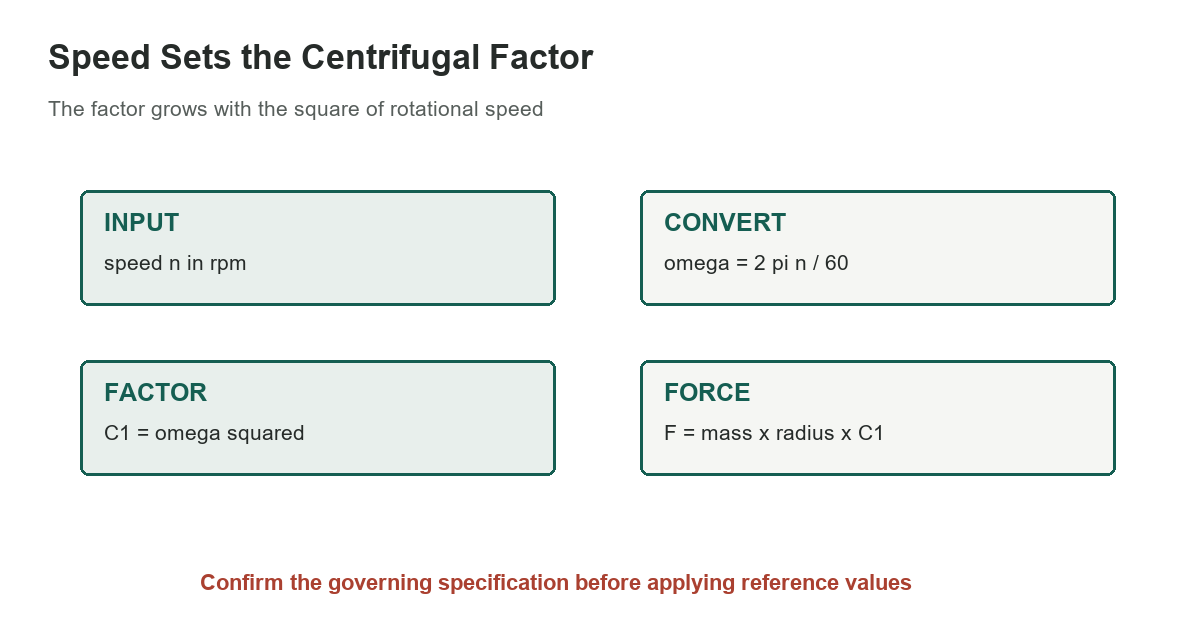
For speed n in revolutions per minute, angular speed is omega = 2 pi n / 60 in radians per second. The acceleration factor is C1 = omega squared. If mass m is in kilograms and radius r is in metres, the basic radial force magnitude is F = m r C1 in newtons. This convention matches the handbook’s metric factor table and avoids mixing pounds, inches, and SI values.
At 100 rpm, C1 is 109.662 m/s^2 in the selected table. A 1 kg mass at a 0.10 m radius therefore gives an idealized force estimate of about 10.97 N. This is a worked calculation from the equation, not a test result or product rating. NIST lists the rpm-to-rad/s conversion factor and identifies rad/s as the unit for angular velocity.
Why speed errors matter
Because C1 varies with the square of speed, doubling rpm multiplies the factor by four. A small speed-unit mistake can therefore create a large force error. Make sure a tachometer value is revolutions per minute rather than revolutions per second, and do not treat frequency in hertz as angular speed without the 2 pi conversion.
Use the exact operating speed and radius to the center of mass, not the outer diameter in place of radius. For an extended object, the simple point-mass equation may not describe the complete stress distribution. A rotor’s geometry, attachments, material, stiffness, imbalance, supports, and critical speeds all affect safe operation.
Define the rotating mass and radius
Use the mass that is actually rotating at the stated radius. If a component has distributed mass, it cannot always be represented by assigning its total mass to the outside edge; force and stress distribution depend on geometry and axis. For a simple attached point mass, measure r from the axis to that mass’s center of gravity.
Check whether the handbook factor is being used in the same form as the design equation. Here C1 is an acceleration, so multiplying by mass alone gives force per unit radius; the complete expression includes both m and r. Keep units attached to every intermediate value so an answer in newtons is not confused with torque, energy, or a balance tolerance.
Do not confuse force with imbalance or balance grade
The equation estimates radial force for a specified mass at a specified radius and speed. Rotating equipment balancing uses additional definitions, tolerances, and procedures. A force estimate alone does not determine allowable vibration, bearing life, fatigue life, or whether a wheel is safe to operate.
For wheels, grinders, fans, pulleys, and vehicle parts, follow the equipment and component manufacturer’s speed markings, inspection limits, mounting instructions, and balance requirements. Never use this table to exceed a rated speed, repair a cracked wheel, or compensate for a missing guard.
Check a calculation before applying it
Record each input with its unit: rpm, kg, and m. Compute omega first, square it to obtain C1, then multiply by mass and radius. Compare the result with an independent calculation or measured design document. Retain enough significant figures during calculation and round only at the final reporting step.
For related rotating machinery, compare the scooter drive-belt size chart and the belt-drive opener guide; neither is a force or balance rating. The benchtop drill-press review covers machine selection, not rotor approval. Follow the component maker’s operating limits and obtain a qualified rotating-equipment assessment when needed.
Sources: Machinery’s Handbook, 31st edition, centrifugal-force Table 6, printed page 195, NIST Guide to the SI, Appendix B.9, NIST Guide to the SI, Chapter 8: rotational frequency