A plastic container, guard, fitting, or shop-made component can look unchanged while a chemical slowly softens, swells, cracks, or permeates it. A broad chemical-resistance chart is a first screen, not permission to store a fluid or put a material into service. Start with the exact product label and the manufacturer’s material designation, then compare the fluid and conditions with a current chart for that product family.
[gs_table id=”11347″]
Read the rating as a screening clue
The short key summarizes the marks used on one historical chart. Its letters are categories, not numerical scores: do not average them, convert them to service hours, or assume that a material marked well for one chemical resists a chemically similar one. A blank or dash is not the same as a confirmed safe result.
The handbook’s original page says the summaries combine multiple sources, that chemicals within one broad class can behave differently, and that the table is instructional rather than design data. The chart also distinguishes asterisked entries and certain exposure temperatures. Use the current material supplier’s full compatibility data for the exact grade, chemical, concentration, and exposure conditions before choosing a part.
Match the whole exposure
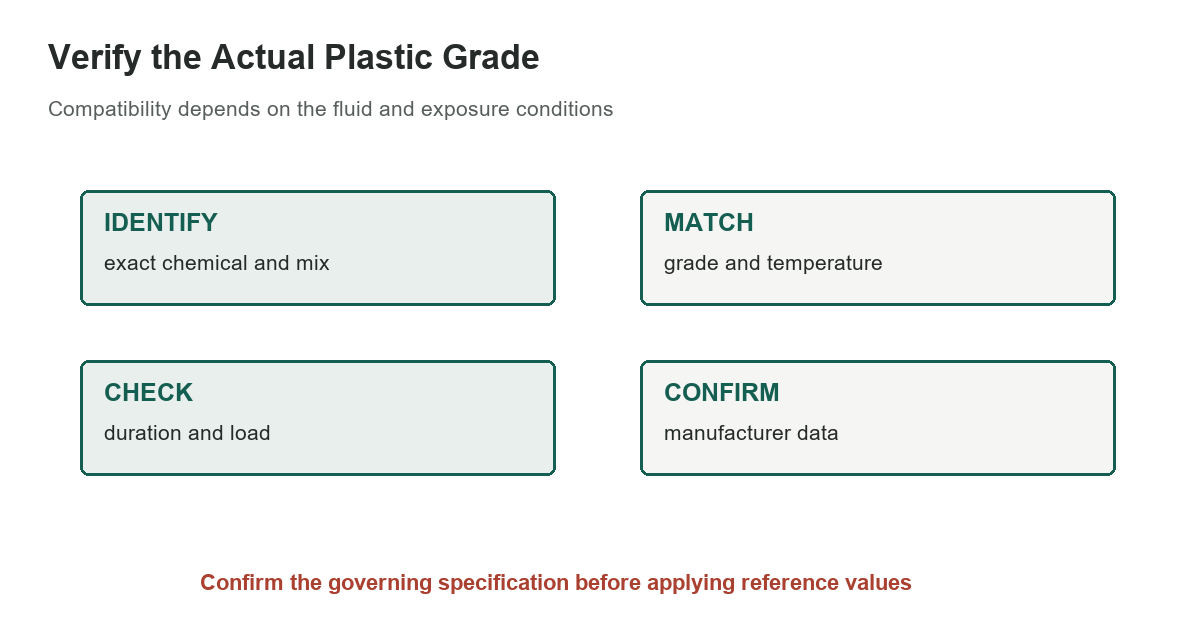
Write down the product’s chemical name, concentration or mixture, operating temperature, contact time, and whether the part is stressed, pressurized, flexed, or exposed to vapor. Include cleaning agents and additives. A manufacturer’s chart may test a material at a stated concentration and room temperature; that rating does not automatically transfer to a hotter, more concentrated, stressed, or continuously immersed use.
For garage work, identify whether the part is a storage jug, drain pan, seal, hose, coating, or protective glove. A chart for a rigid plastic sheet does not establish glove permeation protection, and a chart for a glove does not establish a tank’s structural suitability. OSHA explains that compatibility depends on concentration, thickness, temperature, pressure, exposure time, and product-specific construction.
Find the exact grade, not just the polymer name
Terms such as polyethylene, nylon, PVC, or acetal can cover distinct grades, blends, fillers, processing methods, and additives. Match the molded or printed resin code only as a starting point; it may not identify a precise grade or confirm how a finished product was made. Ask the part maker for its material designation and written compatibility data if the use matters.
Manufacturer charts can disagree because they cover different formulations and test conditions. Ensinger notes that its broad pH guidance assumes room temperature and no mechanical load, and that temperature, concentration, duration, and load matter. Curbell likewise cautions that concentration, time, and temperature affect the chart. Do not combine results from different manufacturers into one universal ranking.
Treat mixtures and unknown fluids cautiously
A trade-name cleaner, brake fluid, coolant, degreaser, fuel blend, or used oil may contain several ingredients. If the safety data sheet lists a mixture or proprietary formulation, do not substitute a generic chemical class. Mixtures may interact differently from their ingredients, and used fluids can contain contaminants not described by the original product label.
When documentation is incomplete, do not test a safety-critical or pressurized part by leaving it soaked and checking whether it looks intact. Permeation or loss of strength may not be visible. Choose a container explicitly intended for the product, follow its storage limits, and obtain the supplier’s recommendation before relying on an unverified material.
A practical verification checklist
Before use, confirm the exact product and plastic grade; the fluid and concentration; the highest expected temperature; contact duration; mechanical stress and pressure; and the manufacturer’s test or compatibility basis. For protective equipment, use the PPE maker’s chemical-specific permeation data and the workplace hazard assessment rather than a chart for bulk plastics. Keep the product label and safety data sheet available.
The garage-door paint guide and garage-floor coating guide cover coating projects, not chemical compatibility approvals. For a separate wall-coating project, see the garage wall painting guide. Stop if the exact grade or exposure condition cannot be verified.
Sources: Machinery’s Handbook, 31st edition, selected original page, Curbell Plastics chemical resistance chart, Ensinger chemical-resistant plastics guide, OSHA Technical Manual: chemical resistance and protective clothing