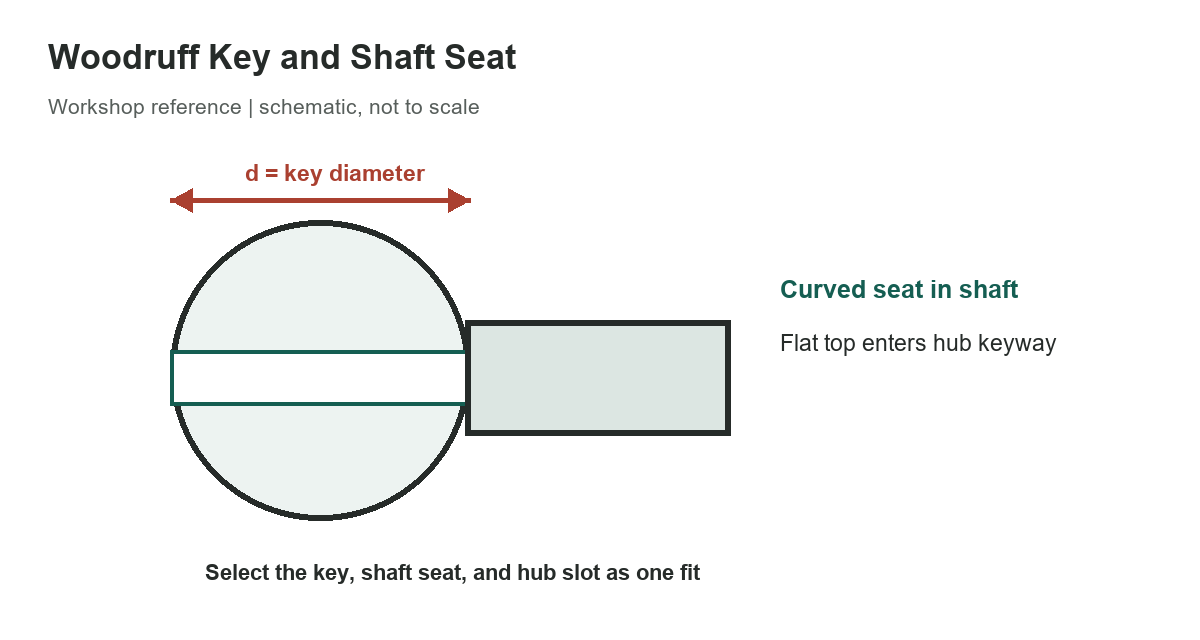
A Woodruff key is a semicircular key that sits partly below the shaft surface and projects into a matching slot in the hub. Its curved seat can help it align in a tapered shaft end, but the key, shaft pocket, and hub slot must be selected as one fit. The values below are selected DIN 6888 sizes and shaft ranges published by a key supplier, not a complete design table.
Read the key size
The listed key designation is b x h x d: width, height, and nominal disc diameter, all in millimeters. The size alone does not describe the shaft pocket or the hub keyway. Use the drawing for the exact seat depth, fit, corner form, and tolerance. A key that fits the slot at rest can still be wrong for the shaft diameter or the torque duty.
The supplier separates shaft ranges for torque-transmitting drives from ranges for location duty. For example, a 2 x 2.6 x 7 mm key is listed for shaft diameters over 5 to 6 mm in torque drives, and over 6 to 8 mm for locating. That distinction matters: selecting only by the shaft diameter can lead to a different key size depending on what the joint must do. The final row has no location-duty range listed by this supplier, so do not infer one.
[gs_table id=”11097″]
Check the mating geometry
The shaft seat is a curved pocket cut into the shaft. The hub has a straight keyway that engages the portion of the key above the shaft surface. Confirm the key orientation, seat depth, hub engagement, and clearance from nearby shoulders. A Woodruff cutter must match the intended pocket geometry; do not treat a general drill diameter as a keyseat-cutter size. The drill-bit size chart is a separate reference for hole-making tools, while reamer-arbor dimensions explain another common shaft-and-tool fit. If the shaft connects to rotating equipment, review the shaft-coupling guard inspection checklist as part of reassembly. For cutter selection, start with the machine and tool maker’s drawing rather than substituting those dimensions.
Woodruff keys are often used where the self-aligning curved seat or a compact hub makes them useful. The curved pocket removes more shaft material than some parallel-key arrangements, so the key form should not be assumed to provide the same shaft strength or torque capacity. DIN 6888 covers dimensions and application for keys, but a dimension chart is not a shaft-design calculation or approval for a loaded drive.
Before ordering or machining
Record the shaft diameter, key width, key height, key diameter, and the mating hub-slot dimensions. Compare the supplier’s range with the actual duty and the machine drawing. Check whether the specified size is DIN 6888 or another key standard; similar nominal labels do not guarantee identical geometry. Also confirm material, hardness, and any special tolerance with the supplier when those properties matter to the assembly.
Do not file a key until it drops into the pocket or use a loose key to take up a worn hub slot. Burrs, damaged key corners, and an incorrectly deep seat can change engagement. For a repair, inspect the shaft and hub for fretting or deformation, then use the specified replacement dimensions and assembly instructions. If the drawing is missing or the joint transmits significant torque, have the fit and load path checked by a qualified designer.
This chart intentionally shows six selected sizes. It does not supply torque limits, shaft-seat dimensions, or material strength values. For the actual part, use the current drawing and standard edition specified by the equipment maker.
References
- DIN Media lists DIN 6888:2022-03 as the current Woodruff-key dimension and application standard.
- Woodstock Industrial’s DIN 6888 reference provides the selected key sizes and separate shaft bands for torque and locating duties.