The International System of Units (SI) has seven base units and 22 derived units with special names and symbols. Those named units make common expressions shorter: a pascal is simpler to read than kilograms per metre per second squared, and a watt is more compact than its full base-unit expression. The table lists all 22 names using current NIST SI guidance.
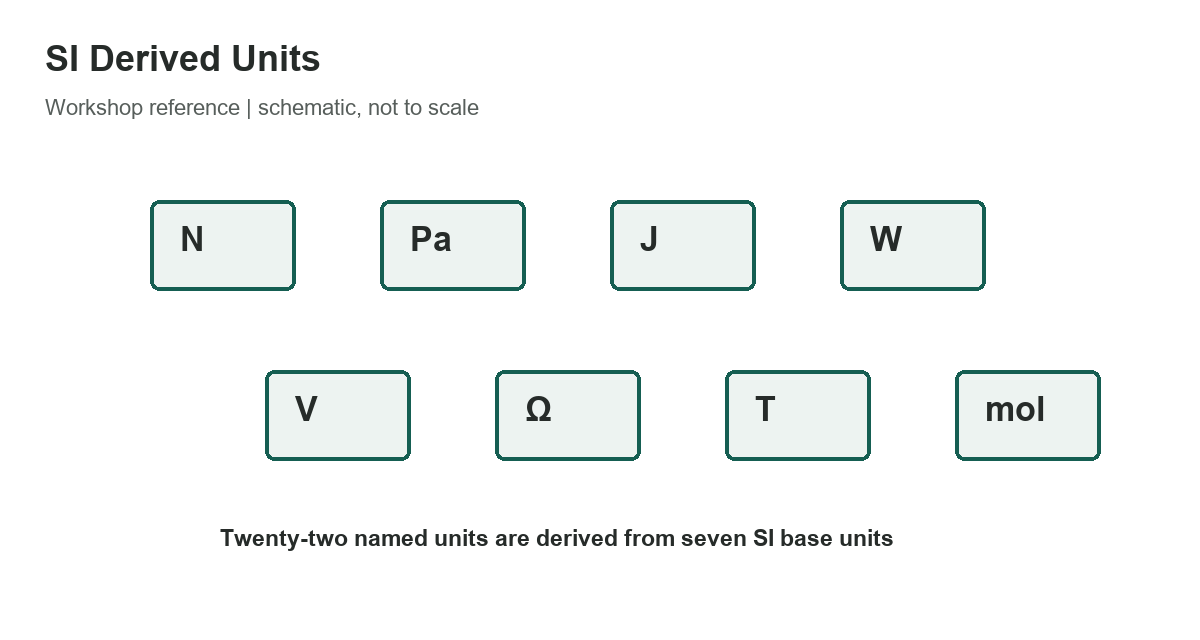
SI derived units at a glance
Base-unit expressions show how each derived unit is constructed from the metre (m), kilogram (kg), second (s), ampere (A), kelvin (K), mole (mol), and candela (cd). Exponents in the table are written with a caret, such as s^-2, for readability. Unit symbols are case-sensitive: N is newton, while n is the prefix nano; Pa is pascal and W is watt.
[gs_table id=”10793″]
Read names and symbols precisely
A unit symbol is not an abbreviation that takes a plural ending. Write 5 kg, not 5 kgs. In running text, unit names are generally lower case even when derived from a person’s name: newton, pascal, joule, watt, and kelvin. The symbol keeps the prescribed capitalization, as in N, Pa, J, W, and K. Degree Celsius is the exception in name capitalization; its symbol is degree Celsius, written °C in typeset text.
Spacing and multiplication also matter. A product such as kg m s^-2 means kilogram times metre times second to the negative second power. A slash can be used for division, but avoid strings of multiple slashes that are hard to parse. Parentheses make compound denominators clearer, for example J/(kg K). The table uses spaces between factors and powers in a plain-text format.
Some units share dimensions but not meaning
Several named units reduce to the same base-unit dimensions. Hertz and becquerel both have the expression s^-1, but hertz describes periodic frequency while becquerel describes radioactive activity. Gray and sievert both reduce to m^2 s^-2, yet they represent different radiation quantities. The quantity being measured determines which unit name is appropriate; matching dimensions alone do not make the quantities interchangeable.
Radian and steradian are dimensionless derived units associated with plane and solid angle. They are useful labels even though their expressions reduce to ratios such as m/m and m^2/m^2. Keeping rad or sr in an equation can make the physical meaning of an angle or angular quantity easier to follow.
Use the right expression for the task
The named unit is often best for communication, while the base-unit expression can help with dimensional analysis. To check an equation, substitute each quantity’s base dimensions and confirm that both sides agree. This can reveal a missing factor of time, length, or mass, but dimensional agreement alone does not prove that the numerical equation or the physical model is correct.
Prefix symbols attach directly to unit symbols, as in kPa or mW. The kilogram is the SI base unit for mass, so mass prefixes are formed using gram: mg, g, and kg. Do not confuse a unit symbol with a quantity symbol, and follow the drawing, instrument, or specification’s declared units when recording measurements.
- Preserve capitalization exactly as specified.
- Do not pluralize or punctuate unit symbols.
- Choose the unit name that matches the measured quantity.
- Use base-unit expressions as a dimensional check, not as proof of a model.
For related measurement references, explore the size-chart library, review the metric and inch pipe reference, and check the compressed-air sizing guide.
Sources
NIST SP 330 Section 2 lists the 22 SI units with special names and their expressions in base units. The BIPM SI Brochure is the international reference for SI definitions and usage. The dataset follows the current NIST table and corrects OCR transcription errors in the historical scan.