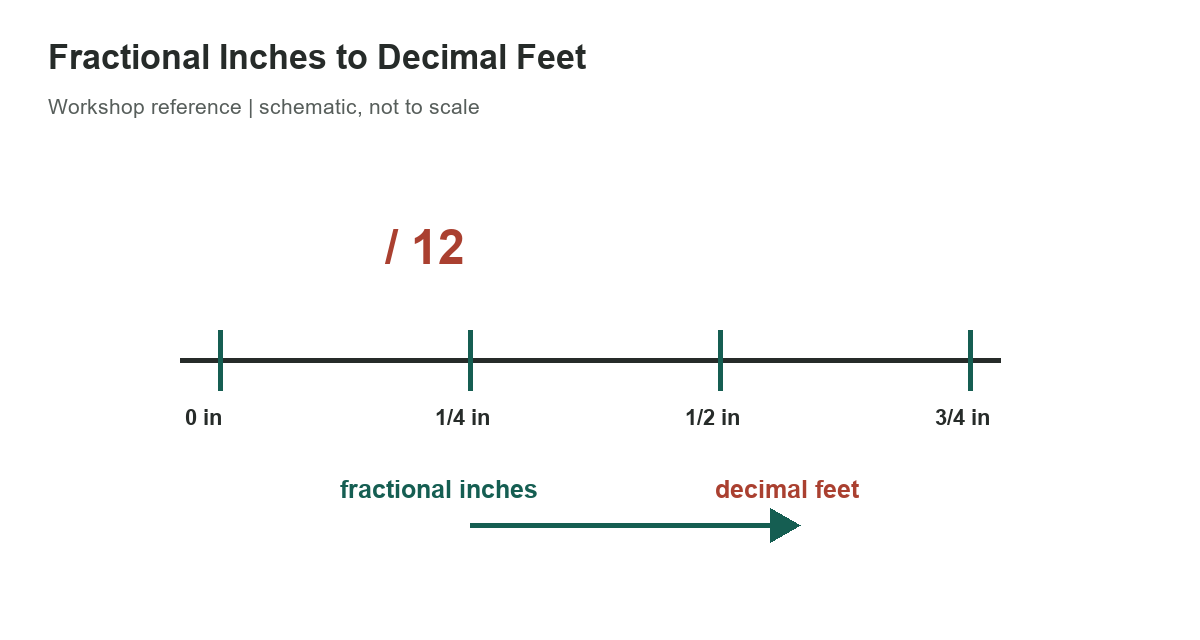
Convert a fractional inch to decimal feet by dividing the inch value by 12. This compact chart covers selected common fractions within one inch; it is useful for a quick estimate or a drawing note, not a replacement for a full conversion calculator or precision measurement.
Apply the conversion
There are exactly 12 inches in one international foot. Therefore, a length expressed only as a fractional inch converts to feet as fraction ÷ 12. For example, 3/4 inch is 0.75 ÷ 12 = 0.0625 foot. The values below are rounded to four decimal places where needed; the fraction remains the exact starting quantity.
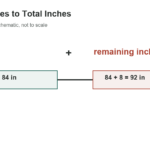
Keep the units visible during the calculation. Dividing inches by 12 inches per foot leaves feet. If the measured length includes whole feet and whole inches, first add the feet and the inch portion divided by 12. Do not divide a total that is already in feet a second time.
[gs_table id=”11059″]
Round to the precision the job needs
Several fractions produce repeating decimals. One sixteenth inch is 0.00520833… foot, shown here as 0.0052 foot. That rounded number is convenient for a chart, but multiplying it back by 12 will not recover the fraction perfectly. Keep the exact fractional input in calculations when rounding could accumulate or affect a tolerance.
For a single short length, four decimal places in feet may be adequate for a rough conversion. For accumulated lengths, machining coordinates, surveying, inspection, or contractual documentation, use the required precision and the controlling unit definition. More decimal places do not make an uncertain measurement more accurate.
Convert mixed measurements carefully
For a measurement such as 2 feet, 5 3/8 inches, calculate 2 + (5 + 3/8) ÷ 12 = 2.447916… feet. Another method is to convert the whole measurement to inches and divide by 12. These methods are equivalent when the unit labels are carried correctly. A fractional-inch-only table like this one covers just the leftover fractional part.
Do not confuse decimal feet with feet-and-inches notation. A result of 1.5 feet means 1 foot plus 6 inches, not 1 foot 5 inches. Likewise, 0.25 foot is 3 inches, not one quarter of an inch. Write the unit after the number whenever a value is copied into a quote, drawing or work order.
Distinguish inch from survey-foot references
The international foot is exactly 0.3048 metre and consists of 12 inches. The U.S. survey foot was retired for most applications beginning in 2023, but historical records may still contain it. This fractional-inch chart uses the ordinary international foot definition; it is not a survey-foot or geospatial conversion chart.
When converting measurements from an older plan, check the document’s stated unit system and datum. A legacy survey coordinate may use a different foot definition than a shop dimension. Do not mix those systems in one calculation without an explicit conversion.
For precise work, preserve the original fraction or measurement and note the rounding rule used for the decimal-foot value. If the source instrument has limited resolution, report uncertainty or tolerance separately rather than implying that a longer decimal is an exact physical measurement.
Worked example
For 5/8 inch, first express the fraction as 0.625 inch. Dividing by 12 gives 0.0520833… foot, displayed in the chart as 0.0521 foot. If that length is added to other dimensions, keep the unrounded value through the sum and round only the final result. This avoids small errors accumulating across several pieces.
For mixed notation such as 3 feet plus 7/8 inch, keep the whole-foot portion separate: 3 + (0.875 ÷ 12) = 3.072916… feet. If the target is a decimal-inch result instead, convert the whole feet to inches first and add the fractional inch. State the destination unit clearly before copying a value into a drawing or estimate.
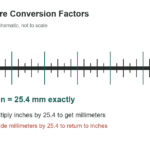
Related conversion references: feet and inches to total inches, exact inch-to-millimetre conversions, and common socket-size conversions.
Formula and scope
The selected values are calculated as fractional inches ÷ 12, rounded to four decimal places. NIST defines the international foot exactly as 0.3048 metre; one foot contains 12 inches. The chart excludes the U.S. survey foot and mixed feet-and-inches entries. NIST international-foot definition; Machinery’s Handbook, 31st edition.