A belt-length correction factor adjusts a belt’s rated contribution within a specified design method. It is easy to mistake this value for a belt-length conversion or a complete horsepower rating. The selected values below are for narrow 3V, 5V, and 8V belt sections; the number is the source’s standard length designation, not a universal length in millimetres.
[gs_table id=”11355″]
Read the designation and factor together
Choose the correct cross-section column first, then locate the standard length designation. The factor is dimensionless. A blank cell means the selected source does not show a value for that profile at that designation; it is not a zero factor and does not authorize interpolation.
Gates’ design manual lists belt references such as 3V-250 and pairs them with an ISO datum length and a CL value. Its 3V-250 example identifies a 635 mm datum length with CL 0.83. This is why the source designation must not be entered as though 250 were a length in millimetres. Different makers and belt families can use other reference lengths or rating conventions.
Keep correction factors separate
The original page places Table 7 length correction factors beside Table 6 arc-of-contact correction factors. They are different adjustments. The selected chart here includes only Table 7 length values; it does not include the arc factor, speed-ratio factor, service factor, or the basic power rating.
A drive calculation uses the full method for the exact belt family and application. A factor above 1.00 does not mean a belt can carry more than its published rating by itself. Likewise, applying a length factor from one manufacturer to another maker’s belt can give an invalid result.
Use the belt maker’s current procedure
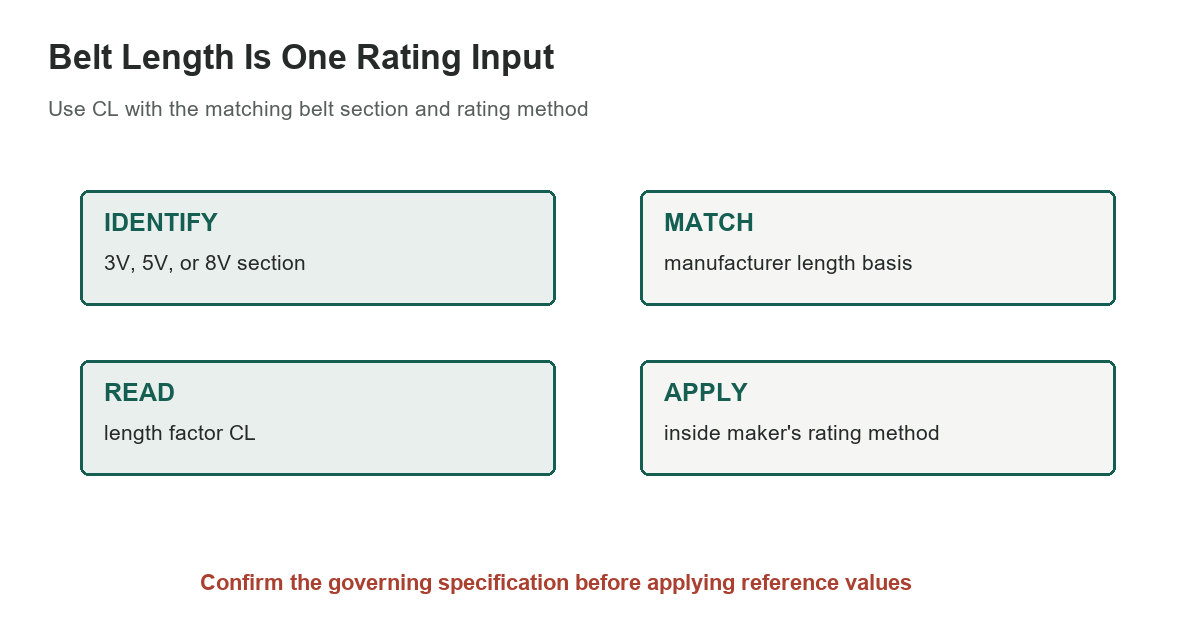
First identify belt section, construction, and reference length from the product label or manufacturer’s catalog. Then use the matching power table and adjustment method. Confirm pulley diameters, speed ratio, small-sheave speed, center distance, wrap, load, and installation tension from the same source. The maker’s current catalog takes precedence over a historical handbook lookup.
The Gates manual explicitly uses both arc-of-contact and length correction factors within a broader belt-drive rating process. This table is a selected reference aid, not a replacement for that procedure, a belt-length measuring guide, or proof that a belt is in stock.
Apply the factor within the full rating method
In the source design approach, the length factor is combined with other correction factors and a base rating according to that method’s definitions. Confirm whether the reference uses datum, pitch, or another length basis and whether its table is for the exact belt section. Similar-looking labels from different manufacturers or generations may use different definitions.
After selecting a candidate, check the manufacturer’s current catalog for allowable power, speed, minimum sheave diameter, installation tension, and belt-length tolerances. Recheck center distance and adjustment range with the actual sheaves. If a machine has unusual starts, shock loads, contamination, or temperature, use the maker’s service guidance rather than assuming the tabulated factor covers those conditions.
Avoid nearby-table mix-ups
A narrow-belt speed-ratio correction changes the rated capacity for a speed ratio; an arc-of-contact factor accounts for wrap on the small sheave; a length factor relates the belt length to its rating method. Similar names do not make these factors interchangeable. Check each symbol and table title before multiplying values.
The belt-drive opener guide describes a different drive application, while the scooter belt chart covers belt dimensions rather than industrial power ratings. For machine context, see the benchtop drill-press review. Use the exact industrial, agricultural, or automotive belt manufacturer’s current rating procedure for the drive at hand.
Sources: Machinery’s Handbook, 31st edition, narrow V-belt Table 7, printed page 2574, Gates Industrial V-Belt Design Manual, selected length correction factors