A zinc-plating record may contain a salt-spray exposure time, but that number is a laboratory acceptance criterion, not a promise of years in service. The handbook’s legacy table lists 96 hours for Type II and 12 hours for Type III, alongside chromate-conversion finish descriptions. It does not identify the edition that governs those durations. Use the values to interpret the historical page only, then check the current drawing, purchase specification, and test criteria before accepting a coating.
[gs_table id=”11409″]
Read the two source values as historical
In the nearby text, Type II is described as having colored chromate conversion and Type III as colorless chromate conversion. The small table assigns 96 and 12 hours, respectively. The table is a record of what this handbook page prints; it should not be detached from its finish definitions or assumed to describe every present-day zinc coating.
The table does not state specimen preparation, exposed area, scribe condition, failure endpoint, sample count, or product service environment. Those details can change what a test result means. A longer chamber exposure is not a direct multiplier for outdoor life, and two products cannot be ranked from the hour count unless the test conditions and acceptance criteria are comparable.
Use the current coating specification
ASTM B633-23 is the active specification for electrodeposited zinc coatings on iron and steel articles. Its scope uses coating-thickness classes and supplementary finish types, including newer non-chromate finishes. The legacy table’s two labels do not represent the complete current system. For zinc-plated mechanical fasteners, ASTM notes that a fastener-specific specification such as F1941/F1941M may be more applicable.
Specify the complete coating requirement, including substrate, coating process, thickness class, supplementary treatment, hydrogen-embrittlement controls where applicable, sampling, and acceptance criteria. Ask the supplier to identify the exact standard and revision used. High-strength steels and safety-critical fasteners require particular care; do not select a coating solely from a short salt-spray number.
Understand what the salt-spray method does
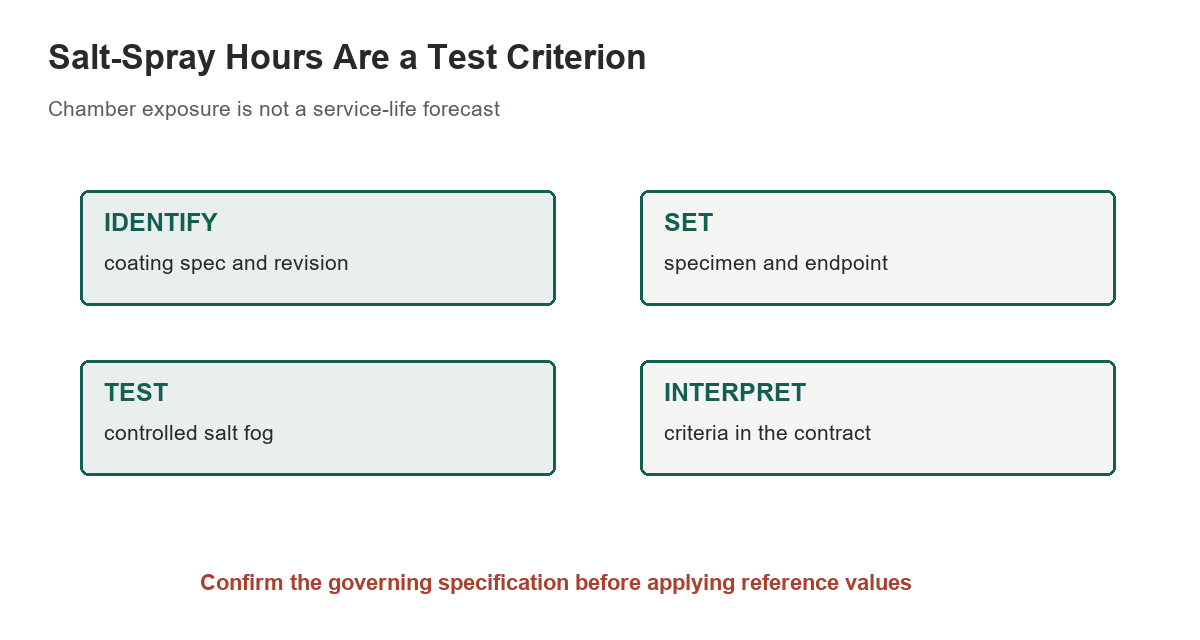
ASTM B117-25 describes the apparatus and conditions for producing a controlled salt-fog environment. It explicitly does not prescribe the exposure period for a specific product or how that product’s result must be interpreted. The applicable product specification, drawing, customer agreement, or test plan supplies those requirements.
A chamber test can be useful for controlled comparison or conformity testing when specimens, operating conditions, and failure criteria are defined. ASTM warns that repeatability depends on specimen type, evaluation criteria, and operating variables, and that similar specimens can vary between chambers. Therefore, hours cannot be converted into a field-life estimate or used alone to predict corrosion protection in a garage, road-salt, marine, or industrial environment.
Keep corrosion topics distinct
The site’s legacy rhodium plating reference concerns a different metal coating. The galvanic corrosion guide addresses dissimilar-metal contact, while the sheet-metal gauge chart identifies substrate thickness. None substitutes for the zinc-coating class and acceptance requirements on a current part drawing.
Before approving a test report
Match the report to the purchase order and drawing revision. Confirm the coating standard and edition, exact finish type, thickness class, specimen or part tested, chamber method, exposure duration, endpoint definition, and any post-treatment. Verify that the report identifies the actual production lot and that the customer or design authority accepts the test method. If a contract specifies an older edition, resolve any proposed change formally rather than silently substituting a current finish type or exposure hour value. Check that the laboratory’s reported observations use the same failure criteria as the specification, and record any permitted touch-up or post-test handling. A certificate stating only a number of hours is incomplete evidence if it does not identify the method, sample, and acceptance requirement.
Sources: Machinery’s Handbook, 31st edition, selected original page, ASTM B633-23: Electrodeposited zinc coatings on iron and steel, ASTM B117-25: Salt spray (fog) test practice