Copper tube letters and abbreviations identify different product families, not interchangeable grades of one universal pipe. Types K, L, and M are ASTM B88 water tubes with progressively thinner walls. DWV, ACR, and medical-gas tubes have separate standards and applications. The correct choice depends on the fluid, pressure, temperature, joint, fitting, environment, and local code.
Identify the tube family before sizing
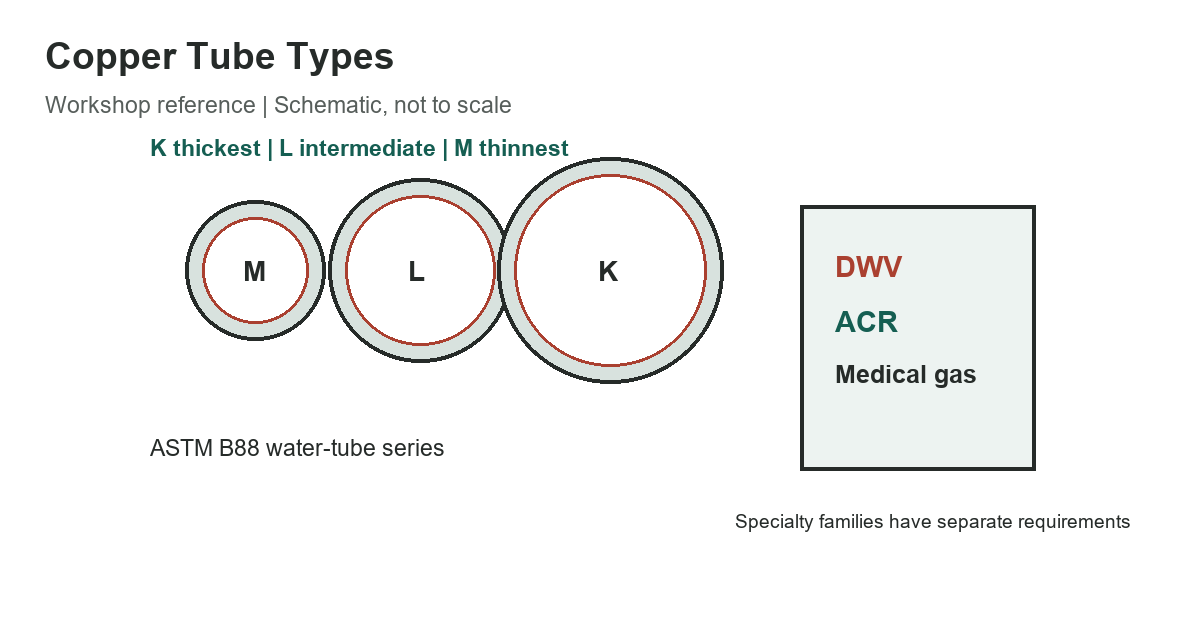
Type K has the thickest wall of the K/L/M water-tube series, Type L is intermediate, and Type M is thinnest for a given nominal size. That changes inside diameter and pressure capacity, so nominal size alone is not enough to select a tube. Type K/L/M tube is commonly identified by a green, blue, or red color mark on drawn products, respectively, but always read the printed or incised product identification.
The table compares several widely encountered families. “Common role” is a starting orientation, not an approval for a particular project.
| K | ASTM B88 | Water tube; thickest K/L/M wall | Size, temper, pressure, code |
|---|---|---|---|
| L | ASTM B88 | Water tube; intermediate wall | Size, temper, pressure, code |
| M | ASTM B88 | Water tube; thinnest K/L/M wall | Verify permitted service and rating |
| DWV | ASTM B306 | Drain, waste, and vent | Do not assume pressure-service approval |
| ACR | ASTM B280 | Air conditioning and refrigeration | Use actual OD and system specifications |
| Medical gas | ASTM B819 | Medical gas, air, and vacuum systems | Required cleaning and health-care codes |
6 rows
Scroll horizontally to view all columns.
Keep the specialty standards distinct
Type DWV is made to ASTM B306 and is intended for drain, waste, and vent applications; do not treat it as a general pressure pipe. ACR tube is covered by ASTM B280 for air-conditioning and refrigeration service and is identified by actual outside diameter. Medical-gas tube is covered by ASTM B819 and requires the specified cleaning, handling, joining, and system procedures.
For pressurized water or compressed air, a tube’s type does not set the complete system rating. The tube size, wall, temper, temperature, fittings, joining method, and manufacturer’s allowable working pressure all matter. Copper Development Association guidance treats K/L/M compressed-air use as dependent on rated internal pressure and recommends brazed joints; the system designer and applicable code must confirm the complete installation.
Joining can change the strength of the finished assembly. Heating hard-drawn tube during brazing can anneal the material near the joint, and fittings may have a different pressure-temperature rating from the tube. Use published system ratings for the actual tube, fitting, joint process, and operating temperature rather than applying a tube-only number to the whole line.
Do not infer fuel-gas approval from the letter
Fuel-gas rules differ by jurisdiction and can specify the approved tube standard, size designation, joint method, protection, and installation location. Requirements in Canada and the United States are not identical. Do not use a generic water-tube chart as a gas piping specification; follow the current local fuel-gas code and work by a qualified installer.
Read the markings and data sheet
Check the manufacturer’s mark, standard, type, temper, dimensions, and any service-specific label. For repair or replacement, match the existing system only after confirming what it carries and its design conditions. ACR lines, medical-gas systems, refrigerants, and potable-water systems have distinct cleanliness and compatibility requirements.
For Types K, L, and M, nominal or standard tube size is not the same as outside diameter; the standard series uses a defined size convention. ACR tube is designated by actual outside diameter. Check the correct dimensional table before choosing fittings, especially when replacing a section that uses a different family.
Color can help identify drawn water tube, but markings differ by temper and product. The CDA notes that annealed coils do not always carry the same color stripe as drawn straight lengths. Read the printed or incised manufacturer and standard markings; do not identify an unlabeled tube by color alone.
- Read the tube marking and governing ASTM designation.
- Separate nominal size from actual outside diameter.
- Match wall, temper, fittings, joints, fluid, pressure, and temperature.
- Use DWV only within its approved drainage application.
- Confirm local code and system ratings before installation.
For related garage utilities, see the natural-gas sizing reference, the LP-gas pipe chart, and the size-chart library. Those charts do not replace local code or a full piping design.
References
Consult the Copper Development Association’s current Copper Tube Handbook and its tube properties and application recommendations.