A legacy drawing may call out an electrodeposited rhodium class even though the cited military specification is no longer used for new design. This compact reference explains the five thickness values printed in MIL-R-46085B and the status notice that accompanies it. It is useful when interpreting an existing record or replacement requirement, not when choosing a coating for new work.
[gs_table id=”11380″]
What the class numbers represent
The source table lists Classes 1 through 5 with increasing nominal thickness values. The metric column below is a unit conversion from inches using 25,400 micrometres per inch; it is not a separate tolerance or a measured coating result. The table does not supply a general process recipe, acceptance test, or performance guarantee.
The same page also contains other metal pretreatment material. Those Type I-V phosphate and pretreatment notes belong to different specifications and are deliberately not combined with the rhodium classes. A shared handbook page does not make coating types interchangeable.
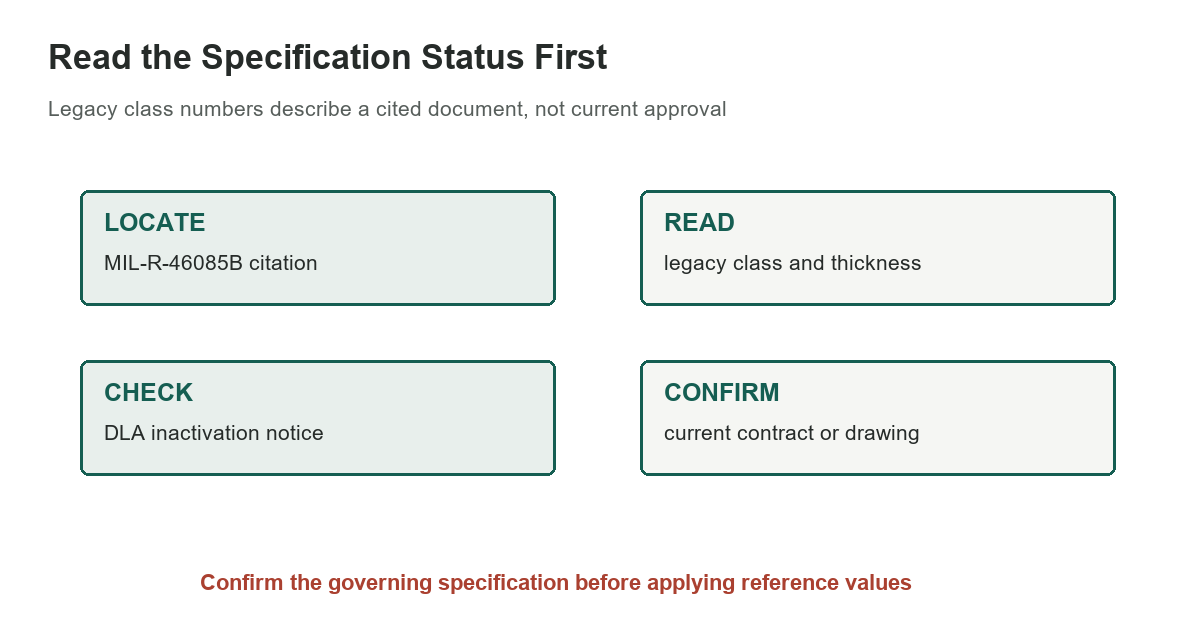
Check the cited specification’s status
DLA Notice 2 for MIL-R-46085B is dated December 18, 1997 and says the specification is inactive for new design and no longer used except for replacement purposes. That status changes how the table should be used: do not treat a historical class as a current purchase specification without confirming the applicable drawing, contract, successor requirement, and approving authority.
For an existing assembly, ask the responsible manufacturer or engineer to identify the exact coating callout and inspection criteria. The class label alone does not state the base material, undercoat, surface preparation, bath chemistry, tolerances, or post-treatment required by a particular job.
Do not turn thickness into a process recommendation
Rhodium thickness can affect cost, reflectivity, wear, and other characteristics, but the table alone cannot predict service life or establish that a coating is suitable for a contact, electrical, optical, or corrosive environment. The requirements depend on substrate, undercoat, geometry, use, inspection, and the governing specification.
Avoid reproducing process conditions from an old document as if they were current instructions. Use a qualified plating supplier and the controlling current documentation for any new work. Where a legacy replacement is explicitly required, document that basis and verify acceptance with the customer or design authority.
Distinguish plating from garage coatings
Electrodeposited rhodium is a specialized metal finish, not a paint or a floor coating. The site’s garage-door paint guide, garage-floor coating guide, and garage wall painting guide concern separate substrates and systems. Their product choices are not substitutes for a metal-plating specification.
What to confirm on a legacy callout
When reviewing an old part record, capture the exact specification number and revision, class, stated thickness, base metal, any undercoat, and referenced inspection method. Compare those details with the drawing revision and the purchase or repair history; a class number by itself may omit requirements that were defined elsewhere in the original specification. If the record is incomplete, ask the customer or design authority to resolve the missing information before requesting a quote. Confirm that the callout applies to the same component revision and service environment; a similar-looking part or an older purchase order is not, by itself, approval to repeat the coating.
For replacement work, have the plating supplier identify which documented process and acceptance criteria can satisfy the approved requirement. Confirm the measuring method and the location at which thickness is evaluated, since geometry and local current distribution can affect deposited thickness. Do not infer optical reflectivity, electrical contact performance, wear life, or corrosion resistance from the nominal thickness column. Those properties depend on the full coating system and the service environment. Retain the approved drawing, supplier process record, and inspection results with the part history.
Sources: Machinery’s Handbook, 31st edition, selected original page, DLA Notice 2: MIL-R-46085B inactive for new design