A tube under external pressure can fail by shell instability or collapse, not simply by the tensile rupture mechanism associated with internal pressure. The handbook page labels its chart for tubes subjected to external pressure and gives selected outside diameters, wall thicknesses, and pressures. Nearby text states a safety factor of 5 and describes tests on tubes from a specific historical source. These are legacy data points, not a pressure rating for a modern tube, pipe, tank, or garage air system.
[gs_table id=”11413″]
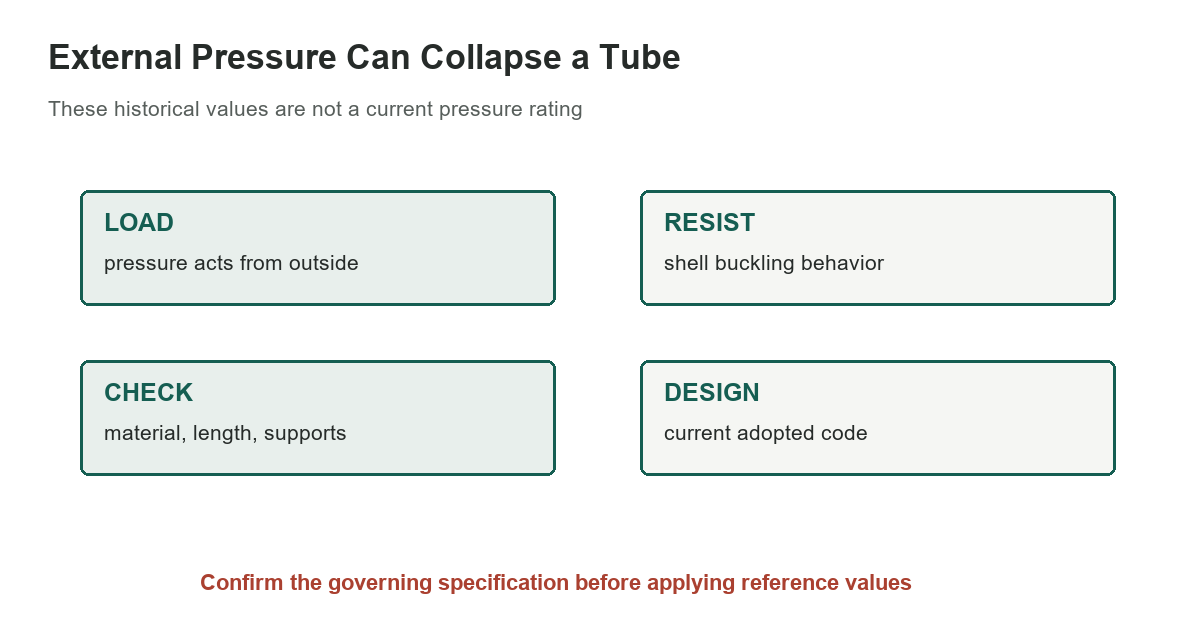
Confirm that the pressure acts externally
The table’s title is decisive: it concerns tubes subjected to external pressure. The tabulated pressure is not an internal working-pressure limit, a burst pressure, or a proof-test pressure. A tube may be exposed to external pressure in a vacuum jacket, submerged application, or other special configuration, but the load path and supports must be evaluated for the actual assembly.
The page’s preceding discussion describes external-pressure behavior and the variability of historical test results. It notes an average yield point for the tested material, but the table does not provide a modern material grade, certified properties, manufacturing route, ovality limits, end condition, corrosion allowance, or complete length/support conditions. A matching outside diameter and wall thickness is not enough to reuse a value.
Notice the stated safety factor
The adjacent source heading states that the listed tube dimensions and maximum allowable pressures use a safety factor of 5. That factor belongs to the historical table’s derivation; it is not permission to apply the same factor to a different material, diameter range, code edition, or design case. The source reports test-based values from tubes made by a historical producer, which limits how broadly they can be applied.
The five rows shown here are selected examples, not the full source chart. A smaller wall thickness or larger diameter can alter buckling behavior substantially. Manufacturing tolerance, roundness, weld seam, temperature, unsupported length, stiffeners, end restraint, cyclic loading, and local damage can all affect collapse. Do not interpolate, extrapolate, or substitute a nominal schedule based on these examples.
Use a current pressure-equipment method
For code-governed pressure vessels, ASME BPVC Section VIII, Division 1 contains current construction rules that include external-pressure design. The governing jurisdiction, adopted edition, material specification, weld details, fabrication tolerances, inspection, and service conditions determine the applicable method. The 2025 edition is the current ASME listing checked for this article, but an installation must use the edition adopted for its jurisdiction and design.
A qualified pressure-equipment engineer should evaluate the complete geometry and loading before a tube is selected. Manufacturer ratings may apply only to specified dimensions, materials, temperatures, end conditions, and test procedures. If the assembly is under vacuum or external fluid pressure, treat the consequence of collapse as a design hazard and use traceable engineering data.
Keep nearby tube references separate
A second lookup on the same handbook page presents selected smaller diameters as maximum pressure for a listed wall thickness; the site’s companion external-pressure wall-thickness chart presents the larger-diameter values in the opposite lookup direction. Both tables concern external pressure. The site’s copper tube type guide and selected copper tube dimensions concern different tubing properties. The Parker Phastite tube ratings are manufacturer-specific product data. Those pages and this historical external-pressure selection are not interchangeable and do not replace the material and design standard for a pressure boundary.
Do not infer a safe operating pressure
A safe design requires the exact material specification and condition, outside diameter, minimum measured wall, length between supports, end restraints, weld efficiency where relevant, temperature, corrosion or erosion allowance, load combinations, and inspection basis. It also requires the current code or accepted engineering method for that equipment category. If any input is unknown, stop short of using a chart value and obtain qualified engineering review. Never pressure-test an improvised assembly to discover its collapse limit.
Sources: Machinery’s Handbook, 31st edition, tubes subjected to external pressure, printed page 294, ASME BPVC Section VIII, Division 1 – 2025