Size an air compressor from the tool manufacturer’s airflow requirement at the stated pressure, not from horsepower or tank size alone. Start with the tool’s average CFM for intermittent work, check the CFM at load when the manufacturer publishes it, and add reserve for pressure drop, duty cycle, and other tools. A short-burst impact wrench and a continuously running sander can have very different compressor demands even when both are labelled as 90-PSI tools.
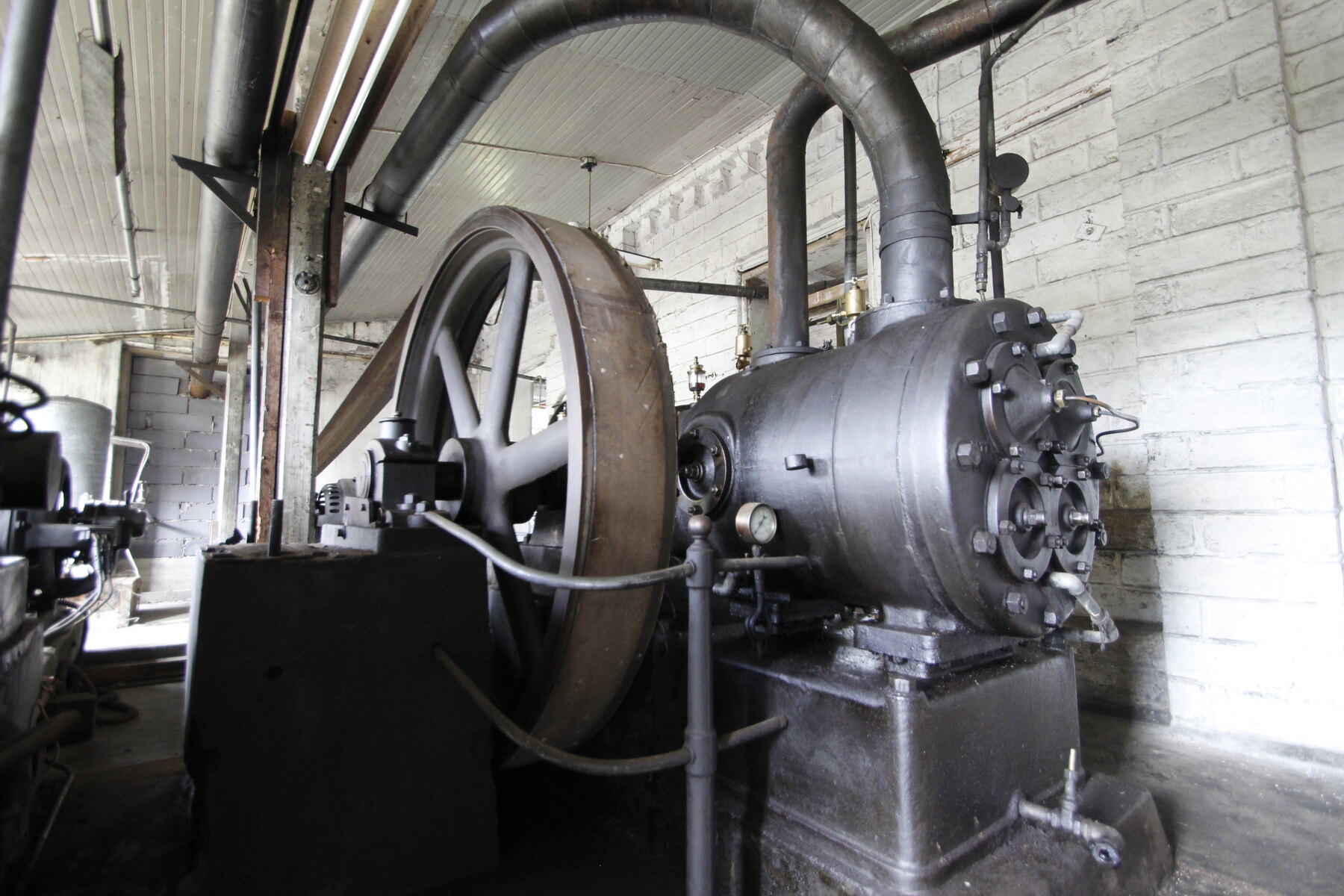
Air compressor photograph by Masugn, Wikimedia Commons, CC BY-SA 4.0; resized and recompressed for GarageSanctum.
Quick compressor-sizing rule
Use this sequence:
- Find the exact tool model and read its air-consumption specification.
- Record the operating pressure and whether the number is average consumption, consumption at load, or a maximum.
- Match the compressor’s delivered airflow at that pressure, usually listed as CFM at 90 PSI or a metric equivalent.
- Add a reserve instead of selecting a compressor that only matches the tool on paper.
- Check the hose, couplers, regulator, filter, and distance between the tank and tool.
For a short-burst impact wrench, a practical starting point is the manufacturer’s average CFM plus a reserve for recovery. For a die grinder, cutoff tool, angle grinder, or dual-action sander, size for the sustained demand and duty cycle. Continuous tools can outrun a small tank even when the compressor briefly reaches the required pressure.
Air tool CFM requirements chart
The figures below are representative reference values, not universal ratings. The tool model, operating pressure, speed, abrasive load, trigger time, and manufacturer test method can change the result. Where the cited source does not publish CFM at load, the cell says so rather than inventing a value.
| Tool category | Representative manufacturer or reference model | Operating PSI | Average CFM | CFM at load where published | Minimum hose size where published | Usage pattern | Source |
|---|---|---|---|---|---|---|---|
| 1/4-inch impact wrench | Reference category band | 90 | 2.5–3.5 | Not published in cited table | Verify tool manual | Short trigger cycles; recovery between fasteners | Kellogg-American air-tool guide |
| 3/8-inch impact wrench | Reference category; choose by exact model | 90 | Use exact model specification | Not published in cited table | Verify tool manual | Intermittent automotive fastening | Kellogg-American air-tool guide |
| 1/2-inch impact wrench | Ingersoll Rand 2135PTiMAX | 90 | 5 | Not published on current page | 3/8-inch | Short bursts; high instantaneous demand can exceed average | Ingersoll Rand 2135PTiMAX |
| 3/4-inch impact wrench | Reference category band | 90 | About 7 | Not published in cited table | Verify tool manual | Intermittent heavy fastening | Powermate buying guide |
| 1-inch impact wrench | Ingersoll Rand 295A | 90 | 11 | 46 | 3/4-inch | Heavy intermittent work; size for recovery at load | Ingersoll Rand 295A |
| Air ratchet | Reference category band | 90 | About 3 | Not published in cited table | Verify tool manual | Intermittent; low average demand but pressure drop affects speed | Powermate buying guide |
| Mini die grinder | Reference category band | 90 | 4–6 | Not published in cited table | Verify tool manual | Semi-continuous; demand rises under cutting load | Kellogg-American air-tool guide |
| Angle or disc grinder | Reference category band | 90 | 5–8 | Not published in cited table | Verify tool manual | Continuous or semi-continuous; high reserve needed | Kellogg-American air-tool guide |
| Dual-action sander | Reference category band | 90 | About 6 | Not published in cited table | Verify tool manual | Sustained sanding; tank size alone is not enough | Powermate buying guide |
| Cutoff tool | Reference category band | 90 | 4–10 | Not published in cited table | Verify tool manual | Sustained trigger time; abrasive load changes demand | Kellogg-American air-tool guide |
| Air drill | Reference category band | 90 | Use exact model specification | Not published in cited table | Verify tool manual | Intermittent to semi-continuous; bit size affects load | Kellogg-American air-tool guide |
| Blow gun | Model and nozzle dependent | 90 maximum is not a universal operating target | Use nozzle specification | Usually not published | Verify nozzle and hose | Brief bursts; unrestricted nozzles can consume substantial air | Quincy compressor sizing guidance |
| Brad or finish nailer | Model dependent | Follow tool manual | Per-shot or low average demand | Usually not published | Follow tool manual | Short bursts; tank recovery is usually more important than continuous CFM | California Air Tools applications |
| Spray equipment | Exact gun, material, and nozzle required | Follow gun manual | Model specific | Model specific | Follow gun manual | Often continuous; oversize the compressor and filtration system | California Air Tools applications |
Average CFM versus CFM at load
Average CFM describes typical consumption over a use pattern. It is useful for intermittent tools because the trigger is not held continuously. CFM at load describes a much higher demand while the tool is doing work. The Ingersoll Rand 295A illustrates the difference: its current specification lists 11 CFM average consumption and 46 CFM at load at 90 PSI.
Do not compare a compressor’s advertised peak airflow with a tool’s average consumption. Use the compressor’s delivered airflow at the same pressure and the tool’s most demanding relevant specification. If the tool manufacturer gives only average CFM, leave additional reserve and watch the pressure during real work.
PSI matters
CFM is not independent of pressure. A tool may be rated at 90 PSI, while a compressor’s output is quoted at 40 PSI, 90 PSI, or another test point. A regulator set below the tool’s required pressure can reduce torque, speed, or material removal. Raising the regulator above the tool’s maximum is not a safe substitute for more airflow.
Use the exact operating pressure from the tool manual. Install the regulator near the point of use and verify pressure while the tool is running, not only with the trigger released. A small gauge reading at rest can hide a large pressure drop through a restrictive coupler or undersized hose.
Simultaneous tools and reserve margin
If two tools may run at once, add their expected demand before adding reserve. For example, a 1/2-inch impact rated at 5 average CFM plus a blow gun used briefly is not automatically a 7-CFM requirement because the use patterns differ. If an impact and a grinder can run simultaneously, use the grinder’s sustained demand plus the impact’s relevant demand, then add margin.
For a single intermittent impact, a compressor that delivers roughly 25 percent more airflow than the average requirement may be a reasonable starting screen, but it is not a guarantee. Continuous tools deserve a larger margin and a test under the real duty cycle. The correct number also depends on altitude, temperature, compressor wear, line length, filter condition, and the pressure at which the compressor unloads.
Duty cycle changes the answer
Tank size controls how long the tool can run before pressure falls; delivered CFM controls how quickly the compressor can recover. A large tank can make a small compressor feel adequate for a short burst, then recover slowly during grinding or sanding. A smaller tank with sufficient delivered airflow may recover faster, but it may cycle more often.
Match the compressor to the work pattern. A nailer or impact used for a few seconds at a time can tolerate more recovery than an angle grinder held on a workpiece for several minutes. Spray equipment and continuous sanding need stable pressure, clean dry air, and a compressor that can keep up without excessive cycling.
Hose and coupler restrictions
The hose is part of the air system. A long, small-diameter hose, restrictive coupler, clogged filter, or undersized regulator can reduce the pressure at the tool even when the compressor is large enough. Use the minimum hose size stated by the tool manufacturer. When no minimum is published, choose a hose and coupler that preserve the tool’s inlet size over the working length and avoid unnecessary quick-connect restrictions.
Keep the air path clean and dry. Drain the receiver, maintain the filter, and use the separator or dryer required by the tool and coating material. Water in a die grinder or spray gun causes different problems from low CFM, and adding a larger compressor does not correct contaminated air.
Worked sizing examples
Intermittent 1/2-inch impact
Suppose the selected impact is the 5-CFM-average Ingersoll Rand 2135PTiMAX at 90 PSI. Start with a compressor whose delivered airflow is comfortably above 5 CFM at 90 PSI, not a model whose marketing number is only peak CFM at a lower pressure. Add reserve for recovery, use the specified 3/8-inch minimum hose, and test the pressure while loosening several fasteners in succession.
Continuous grinder
Suppose a reference angle grinder uses 5–8 CFM at 90 PSI. Size toward the high end if the trigger will stay open and the abrasive will remain loaded. Add reserve for hose loss and allow the compressor to recover without falling below the tool’s operating pressure. A tank that supports one short pass does not prove the compressor can support a full panel or weld-cleaning session.
One impact plus one continuous tool
If a 5-CFM-average impact and an 8-CFM grinder may run together, treat 13 CFM as the starting simultaneous demand, then add system margin. If the impact is only used for brief bursts, the real average may be lower, but the grinder still determines the continuous baseline. This is why a single category chart cannot replace the planned duty cycle.
What to record before buying
Record the exact tool model, pressure, average CFM, CFM at load, minimum hose size, expected trigger time, and whether another tool will share the line. Record the compressor’s delivered airflow at the same pressure, receiver size, voltage, and duty-cycle rating. If the manufacturer provides a manual rather than a product-page number, use the manual and keep the revision date with your shop notes.
For broader selection help, see GarageSanctum’s air-compressor size guide, air-compressor types guide, and tire compressor guide. For impact-wrench recommendations, use the product-specific CFM and pressure data before choosing a compressor.
Sources and method notes
The table combines current manufacturer specifications where available with clearly labelled reference bands from Kellogg-American, Powermate, and Quincy Compressor. The representative manufacturer rows use the current Ingersoll Rand 2135PTiMAX page and 295A page. Re-check the exact tool manual before publication because CFM, pressure, hose requirements, and product availability can change.