SI prefixes attach decimal powers of ten to unit symbols, making large and small measurements easier to write. The prefix changes the magnitude, not the kind of quantity: a millimeter remains a length and a megawatt remains a power. The selected examples include four prefixes added in 2022, which are missing from older reference charts. For nearby size references, see our bolt spanner chart, metric socket-head cap-screw chart, and socket-size guide.
Selected current SI prefixes
The table samples prefixes across large and small powers rather than repeating the complete official list. The ronna, quetta, ronto and quecto names and symbols were adopted in 2022. NIST’s current page lists 24 recognized prefixes spanning 10^30 through 10^-30.
[gs_table id=”10900″]
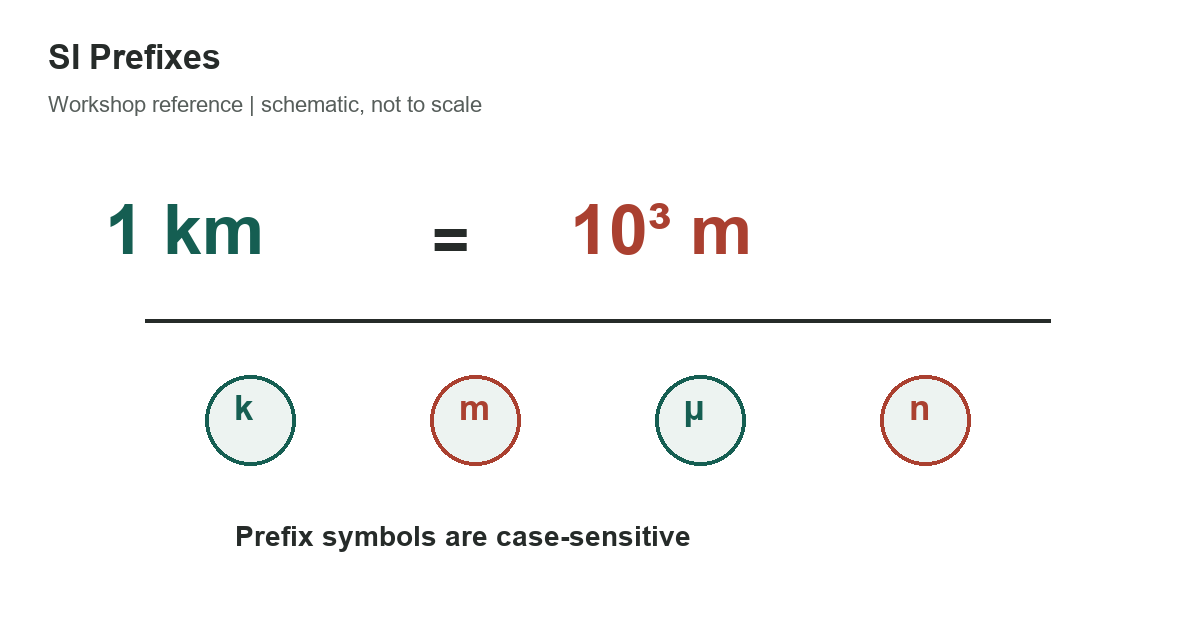
To read a prefixed quantity, multiply the base unit by the stated factor. One kilometer is 10^3 meters, or 1,000 meters. One millimeter is 10^-3 meters, or 0.001 meter. One microsecond is 10^-6 seconds. The exponent tells you how many powers of ten are involved; it is not a unit conversion between different physical quantities.
Use symbols with care
Prefix symbols are case-sensitive. Uppercase M means mega, or 10^6, while lowercase m means milli, or 10^-3. Confusing them changes the value by a factor of one billion. Similarly, G is giga and g is the gram unit symbol; symbols should be copied exactly from the official SI reference.
Prefix names are written in lowercase except at the start of a sentence. Symbols are upright and are attached directly to the unit symbol without a space: km, mA and µm. A space separates the numerical value from the unit, as in 12 mm. The numerical value and unit should stay together when a line wraps, so use a nonbreaking space in formatted technical copy when possible.
Do not combine prefixes. A prefix is applied once to a unit symbol; forms such as “millimicro” are not accepted SI notation. For compound units, apply the prefix to one unit symbol and keep the exponent with that unit, such as mm². Be careful with area and volume: 1 cm² equals 10^-4 m², not 10^-2 m², because the conversion factor is squared.
Prefixes and mass
The SI base unit of mass is the kilogram, which already contains the prefix kilo in its name. For multiples and submultiples of mass, SI prefixes attach to the gram symbol g: mg, g, kg and Mg. The notation “µkg” is not used. A megagram is 1,000 kilograms and is also commonly called a tonne, symbol t, although tonne is not an SI unit.
Older technical charts may stop at yotta and yocto, the largest and smallest prefixes recognized before 2022. NIST and the BIPM added ronna and quetta at the large end and ronto and quecto at the small end. When maintaining an old drawing, worksheet or instrument display, do not assume a legacy prefix list includes these additions or that every instrument supports them.
Check the quantity before converting
Before applying a prefix, identify the complete unit and what the instrument measures. A value in mA is current, while mAh is electric charge or battery capacity; the shared letters do not make them interchangeable. Likewise, kW measures power and kWh measures energy. A prefix conversion cannot fix a mismatch in physical dimensions.
For critical shop measurements, record the original value, unit, conversion factor and rounded result. Keep guard digits through the calculation and round only at the end to match the instrument resolution and required tolerance. If the source is ambiguous about a decimal point or symbol case, verify it against the drawing, instrument manual or current SI publication.
Sources
Use NIST’s current SI prefix reference and the BIPM SI Brochure for the complete official list and formal notation.