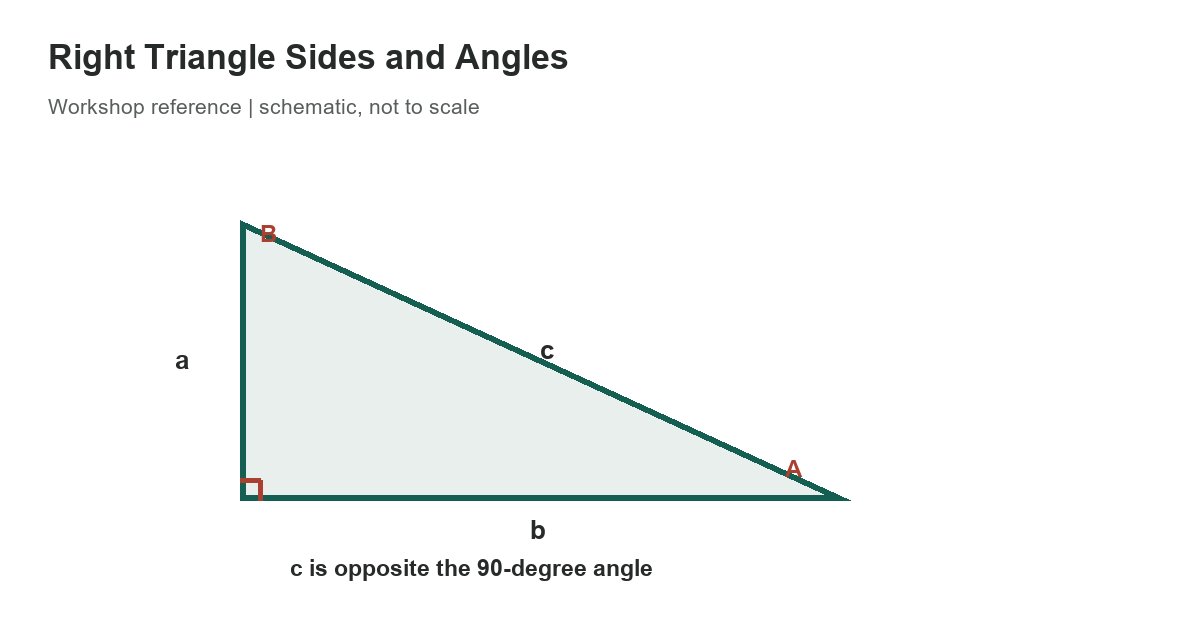
A right triangle has one 90-degree angle. Label the two legs a and b, the hypotenuse c, and the acute angles A and B, with each side opposite its matching lowercase angle. The table gives selected ways to find a missing side or angle from two independent known values. Use the row that matches the measurements you actually have.
Choose a formula from the known values
The hypotenuse is the side opposite the right angle and is always the longest side. Angles A and B are complementary: A + B = 90 degrees. For angle A, sin A = a/c, cos A = b/c, and tan A = a/b. For angle B, sin B = b/c, cos B = a/c, and tan B = b/a. Inverse functions such as asin and atan return an angle; use the calculator’s degree mode when your measurements are in degrees.
[gs_table id=”11134″]
Worked layout example
Suppose a rectangular brace layout has horizontal leg b = 240 mm and vertical leg a = 180 mm. The diagonal is c = √(240² + 180²) = √90,000 = 300 mm. The angle at the lower-right corner is A = atan(180/240) ≈ 36.87 degrees, and the other acute angle is B = 90 − A ≈ 53.13 degrees. The dimensions are exact inputs for this ideal right triangle; a real part still needs the specified tolerance, edge condition, and measurement method.
Check assumptions and calculator settings
The formulas assume a planar right triangle and consistent length units. They do not determine whether an assembly is square, whether a brace fits around obstructions, or how much material to add for a cut. If the drawing gives only approximate side measurements, the calculated angle and diagonal are approximate too. For small angles, rounded side measurements can produce a noticeable change in the result.
When both legs are measured, calculate the hypotenuse first with the Pythagorean theorem. For an angle, choose the ratio that uses the two sides you know: sine compares opposite to hypotenuse, cosine compares adjacent to hypotenuse, and tangent compares opposite to adjacent. For example, if a rise and run are available but the diagonal is not, tangent gives the angle directly. If a side and angle are known, multiply or divide by the matching ratio; check that the result is greater than zero and shorter than the hypotenuse when it is a leg.
Keep the calculator in degree mode for degree inputs and label the answer with its unit. A common error is to enter a degree value while the calculator expects radians; another is to use the inverse sine key when the known sides are opposite and adjacent, which calls for inverse tangent. Round only after the calculation, and do not report more precision than the measuring tools support. A layout with a 1 mm measurement uncertainty does not become a micrometer-accurate diagonal because the calculator displays many digits.
If the triangle is being used to lay out a cut, verify the angle with a square or a second independent measurement when the fit is important. The equations solve ideal geometry; they do not account for blade kerf, stock movement, joint clearance, or deflection during measurement.
Do not use this right-triangle chart for a non-right triangle without a suitable method such as the law of sines or cosines. When an angle is found with an inverse trigonometric function, check that the calculator reports the expected range and unit. Use a known 3-4-5 triangle or the worked example as a quick arithmetic check.
For adjacent shop references, see our regular-polygon layout factors, countersink angle and depth factors, and fractional-inch to decimal-foot conversions. Each addresses a different geometry or unit-conversion task.
References
- NIST Digital Library of Mathematical Functions defines right-triangle sine, cosine, and tangent relationships.
- OpenStax right-triangle trigonometry reviews the Pythagorean theorem and trigonometric functions.