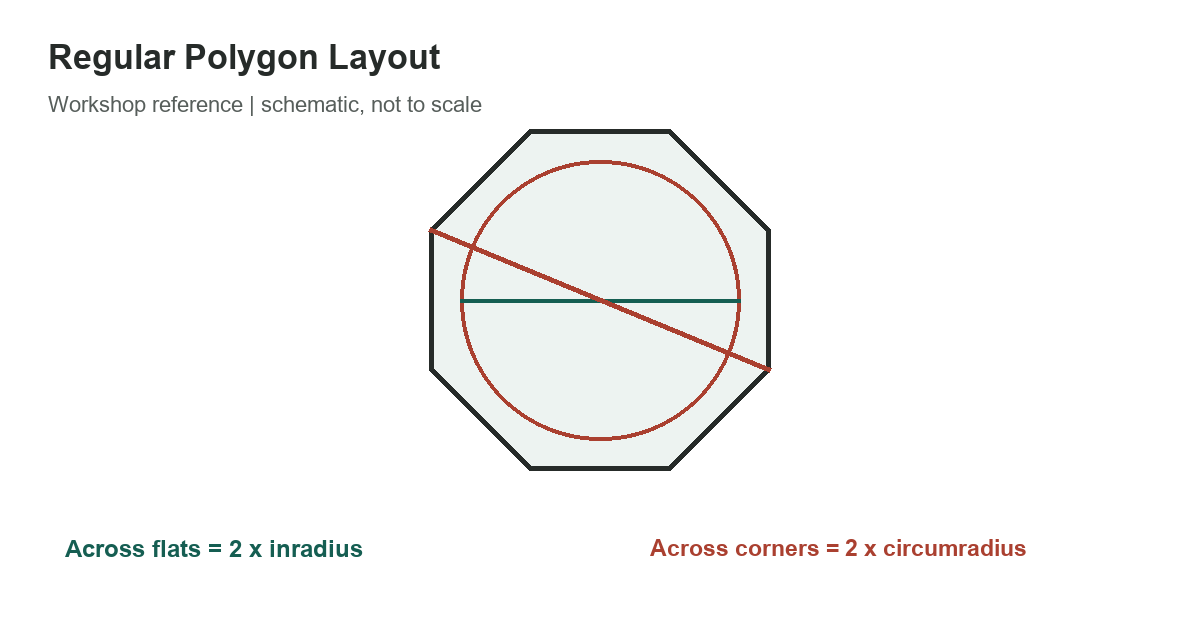
When laying out a regular polygon from its apothem, the number of sides determines both the corner-to-corner span and the length of one side. The chart uses twice the apothem as its reference dimension; for even-sided polygons this is also the across-flats dimension. This chart gives those length ratios for selected regular polygons. It does not calculate area. Other useful shop references include our reference chart library, the bolt measurement chart and the American wrench size chart.
Layout factors from twice the apothem
Let a be the apothem, the perpendicular distance from the polygon center to a side, and set F = 2a. For even-sided polygons, F equals the distance between opposite parallel sides. For odd-sided polygons, F is only a calculation reference: there is no opposite side pair. Across corners is twice the circumradius, measured between opposite vertices. The table uses ideal geometry and rounded factors, not manufacturing tolerances.
[gs_table id=”10929″]
Use the factors
For a regular n-sided shape, let a be its apothem, F = 2a, C its across-corners dimension, and S one side length. The ratios are C/F = sec(180 degrees/n), equivalently 1/cos(180 degrees/n), and S/F = tan(180 degrees/n). For even n, F is the across-flats dimension. For odd n, use 2a as a reference input rather than treating it as a measured across-flats span. These relationships follow from splitting one center-to-side triangle into two right triangles.
For a regular hexagon, opposite flats exist. With F = 40 mm, the across-corners span is 40 x 1.1547, or about 46.19 mm, and one side is 40 x 0.5774, or about 23.10 mm. Keep guard digits during calculations and round only to the resolution appropriate for the drawing or measuring tool.
Regularity and measurement limits
The formulas assume equal side lengths and equal interior angles, with the polygon centered and measured in a plane. A worn, distorted, cast or fabricated part may not be regular. For an actual component, measure the relevant flats and corners directly in several orientations and record the largest and smallest readings when ovality or distortion matters.
For odd-sided polygons, do not call 2a an across-flats measurement. If a physical envelope width is needed, specify the orientation and the two parallel support lines that define that width, then calculate or measure that span separately.
Do not use rounded factors as tolerance limits. If the layout is precision-critical, calculate from the exact side count and measured dimension using full-precision trigonometric functions, then compare the result with the part drawing and the measurement uncertainty. Polygon factors do not establish a fastener’s wrench size, fit class, strength or interchangeability.
When using a caliper or layout tool, decide whether the target is the theoretical ideal dimension or the measured envelope of a finished part. Burrs, chamfers and corner radii can make a direct across-corners reading differ from the sharp-vertex construction assumed by the formulas. Identify the intended contact points and state them on the drawing so another person can reproduce the measurement.
For a regular n-sided polygon, the central angle between adjacent vertices is 360 degrees/n. Bisecting that angle creates a right triangle whose half-angle is 180 degrees/n; applying sine and cosine gives the side-to-inradius and circumradius-to-inradius factors. This derivation is why the selected side count must be an integer and the shape must be regular.
Keep area separate from length
The values in this table convert one length to another length. They do not provide perimeter or area. If area is required, use the appropriate regular-polygon area relationship with a clearly identified apothem, side length or circumradius. Do not square a rounded length ratio without checking the required precision and the correct geometric formula.
For a physical layout, mark a center datum, establish the orientation of the first side or vertex, and verify the final closure before cutting. A small angular error accumulates around the perimeter and can leave a gap or overlap. Use a full-size drawing or a suitable indexing fixture when the polygon needs to be repeatable.
Sources
OpenStax’s polygon reference defines regular polygons; its formula review confirms the related radius and apothem definitions. The displayed length factors are calculated from those geometry relationships using twice the apothem as the reference dimension; no area values are included.