A hardened beveled washer is a structural fastener component, not simply a thicker version of a flat washer. Its sloped bearing face can help align the bolt head or nut with an inclined surface, while the square or rectangular outline helps resist rotation. The selected dimensions below cover nine inch-series nominal sizes. They are dimensional reference values, not a design check for a bolted connection.
[gs_table id=”11330″]
Why the bevel matters
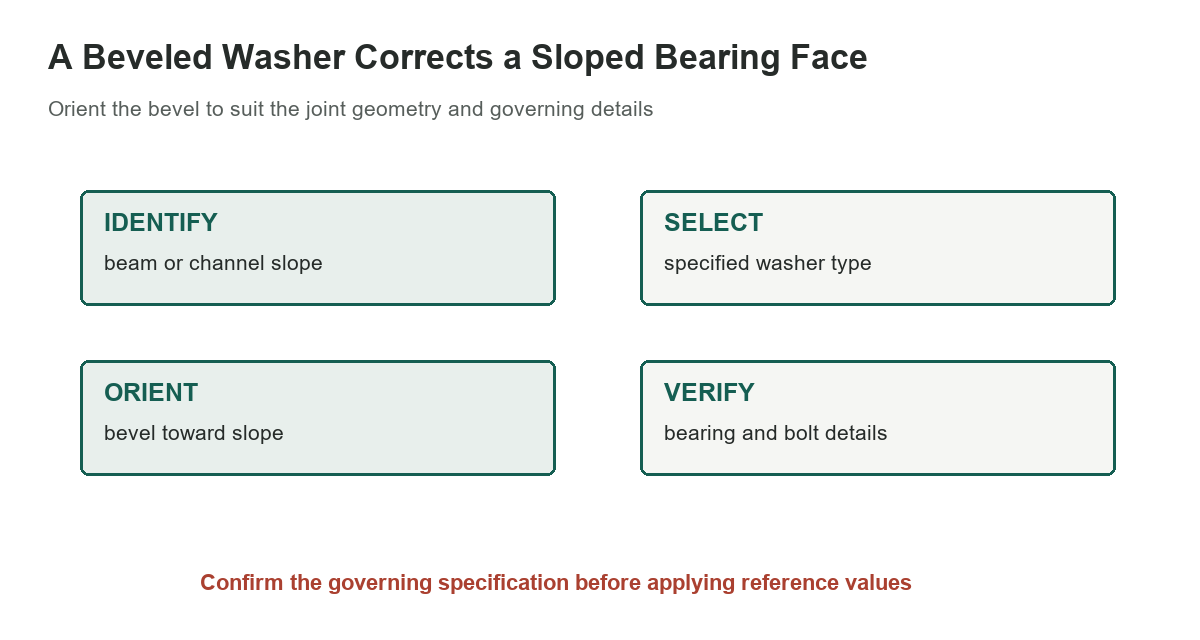
AISC explains that the bearing surfaces under a bolt head and nut should be sufficiently close to perpendicular to the bolt axis. Rolled beams and channels can have sloped flanges, so a beveled washer may be needed on the inside face to provide the required parallelism. AISC also notes that the bevel must be oriented in the proper direction; the washer’s geometry does not make orientation automatic.
A washer cannot correct every joint detail. Confirm which face is sloped, where the washer belongs, and whether the design calls for a beveled washer, a plate washer, or another detail. Follow the governing RCSC specification, contract documents, and engineer-of-record drawings for the connection.
Understand the dimensions
The table separates the basic inside diameter from the listed plus tolerance. Add those values to find the maximum inside-diameter limit in this source; the source lists a zero minus tolerance. Minimum side length and thickness describe the washer body, while minimum edge distance identifies a geometry requirement associated with the beveled edge. The source specifies a 1:6 taper. These columns do not establish hardness, coating, material grade, proof strength, or suitability for a particular bolt assembly.
ASME’s B18.2.6-2019 standard covers general and dimensional data for inch-series structural fasteners, including hardened steel washers that may be circular, circular-clipped, or beveled. ASME cautions that dimensional inclusion does not guarantee all sizes are stock items. Check the applicable product designation and supplier documentation before ordering.
Do not confuse nominal size with hole fit
The nominal washer size is associated with the bolt size, but the inside diameter has its own basic value and tolerance. It should not be used as a substitute for checking the connected-part hole, bolt diameter, slot, or edge distance. The source’s plus tolerance is 0.0313 in. for the listed rows and the minus tolerance is zero; this is not a general tolerance for all washers.
Use a controlled drawing or standard when a dimensional limit matters. A visually similar washer may be plain, flat, hardened, circular-clipped, or beveled and may not meet the specified structural fastener requirements. Markings, packaging, traceability, and material certification can matter on engineered structures.
Check the connection as a system
Washer selection sits within a bolted-joint design. Bolt grade and diameter, hole type, grip, connected material, surface slope, required pretension, and installation method all affect the joint. The washer alone does not carry or certify the connection. Do not infer a torque, bolt capacity, or slip resistance from the dimensional values in this chart.
Before installation, verify the specified washer under the correct bolt head or nut, orient the bevel as detailed, and make sure the bearing face is stable. Follow the project procedure for tightening and inspection; torque values are not interchangeable across lubricants, coatings, fastener lots, or installation methods.
Use the reference carefully
The table is most useful for comparing selected dimensions after the exact washer type and standard have been identified. It can help flag a likely mismatch in nominal size, inside diameter, or body dimensions, but it cannot replace inspection documents or supplier confirmation. If the requested dimension is unavailable in the selected series, do not interpolate or substitute without approval.
For related shop-tool context, see the site’s socket-set guide and nutsert size chart; neither covers structural washer selection. The bench-vise guide is also not a fastener design reference. Have a qualified structural engineer resolve any connection ambiguity.
Sources: ASME B18.2.6-2019 Fasteners for Use in Structural Applications, AISC bolting FAQ: beveled washer requirements, Machinery’s Handbook, 31st edition, Table 8, printed page 1710