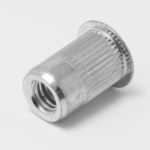
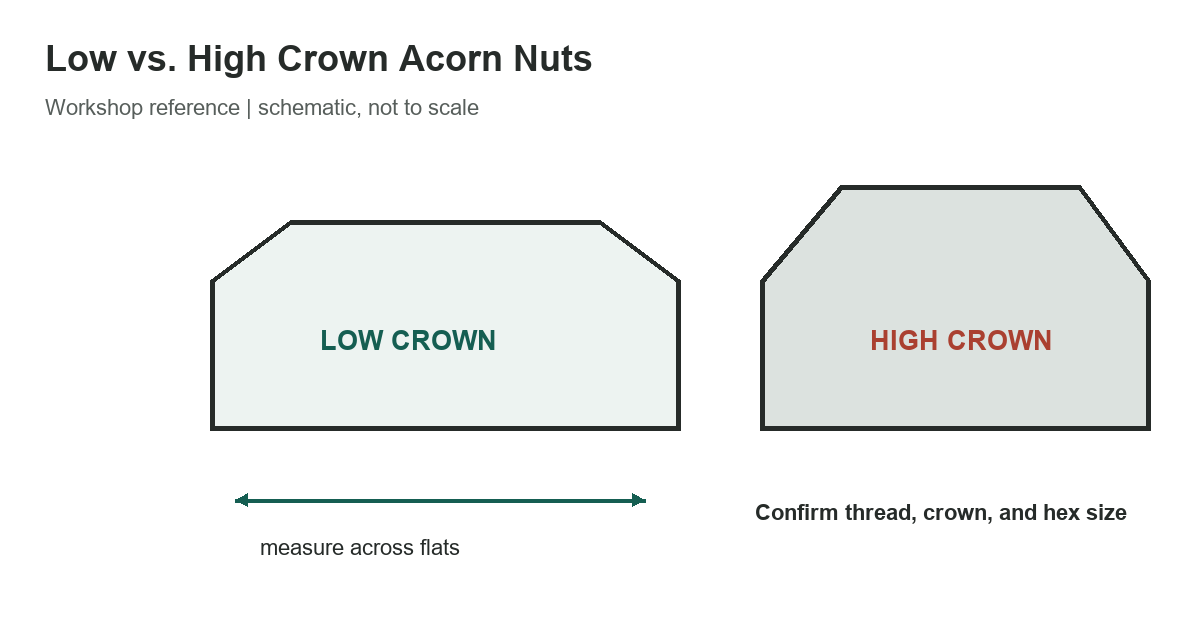
Low- and high-crown acorn nuts cover the exposed end of a threaded fastener. The crown profile changes the overall height, while the thread and hex dimensions still need to match the bolt or stud and the available wrench clearance. “Acorn nut” alone is not a complete specification: SAE J483 and metric DIN cap nuts are different dimensional systems, and products sold under the same informal name can use different constructions.
Selected SAE J483 dimensions
The comparison below lists selected inch-series examples. Width across flats is the maximum hex dimension; crown height is the overall dimension shown for the low- or high-crown type. The 3/4-inch row is 1-1/16 inches across flats, not 11/16. The high crown provides more cover height, but that extra height does not by itself indicate a stronger nut or a longer usable thread.
[gs_table id=”10760″]
SAE’s J483 recommended practice covers complete general and dimensional data for high- and low-crown blind/acorn hex nuts, primarily for automotive and other ground-vehicle or industrial closure applications. The current SAE listing marks the 2016 revision stabilized. The values shown here are a limited reference, not the full standard and not a substitute for the exact product drawing or purchase specification.
Choose the type that fits the assembly
First match the nominal thread diameter and pitch. A 1/2-13 nut is not interchangeable with a 1/2-20 nut. Check whether the fastener is UNC, UNF, or another specified series, and confirm the actual bolt or stud. Next confirm the nut’s thread depth and internal clearance: the domed cap must not bottom on the end of a long fastener before the hex seats on the joint. The listed crown height is not the same as the maximum usable protrusion because internal shape and thread depth vary by product.
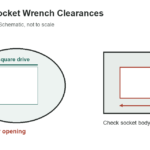
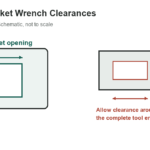
Then check the wrench dimension across flats and the space around the installed nut. A decorative cap can have a larger exterior envelope than a standard hex nut. Account for adjacent parts, sockets, access angle, and the tool needed for installation. High-crown versions need more vertical clearance; low-crown versions reduce the profile but may offer less cap depth. Confirm the exact overall height on the maker’s drawing when clearance is tight.
Construction matters too. Some low-crown steel cap nuts are made from a hex nut with a separate acorn-shaped cap, while other products are one-piece. Material, plating, corrosion environment, temperature, load, and thread engagement should be specified separately. Do not assume a cap nut is suitable for a structural or safety-critical joint because its outside dimensions look right. Use the fastener grade and joint design required by the application, and verify that the cap does not compromise engagement.
Measure and order accurately
Measure width across the flats, not the corners. Measure overall height from the bearing face to the top of the crown. If identifying an unknown part, inspect thread diameter and pitch with the correct gauges, and do not force a test bolt into the nut. Compare both the thread designation and actual hex measurement to a product drawing. Plating buildup, manufacturing tolerance, and wear can affect a field measurement.
For a purchase request, state the thread size and series, low or high crown, one-piece or specified construction, material and grade, finish, and any required standard. Ask the supplier to confirm the drawing revision and dimensions. If the cap is used only as a cover, verify that the underlying joint still meets its fastening requirements; the ornamental appearance is not a load rating.
- Match thread diameter and pitch first.
- Check wrench clearance and the nut’s overall height.
- Confirm crown type, construction, material, and finish.
- Use the exact supplier drawing for final acceptance.
Explore the reference chart library, compare bolt and wrench sizes, and review the socket size guide when planning tool access.
References
Consult the SAE J483 listing and a current supplier drawing. The selected figures were cross-checked against a published J483 dimension listing.