A volume formula is useful only when the measured object matches the geometric model. A right cylinder, a ring torus, and a barrel-shaped vessel are not interchangeable shapes, even if they share a diameter and height. This reference puts familiar solids beside selected special cases and states the assumptions needed to use each equation.
[gs_table id=”11088″]
Define the dimensions first
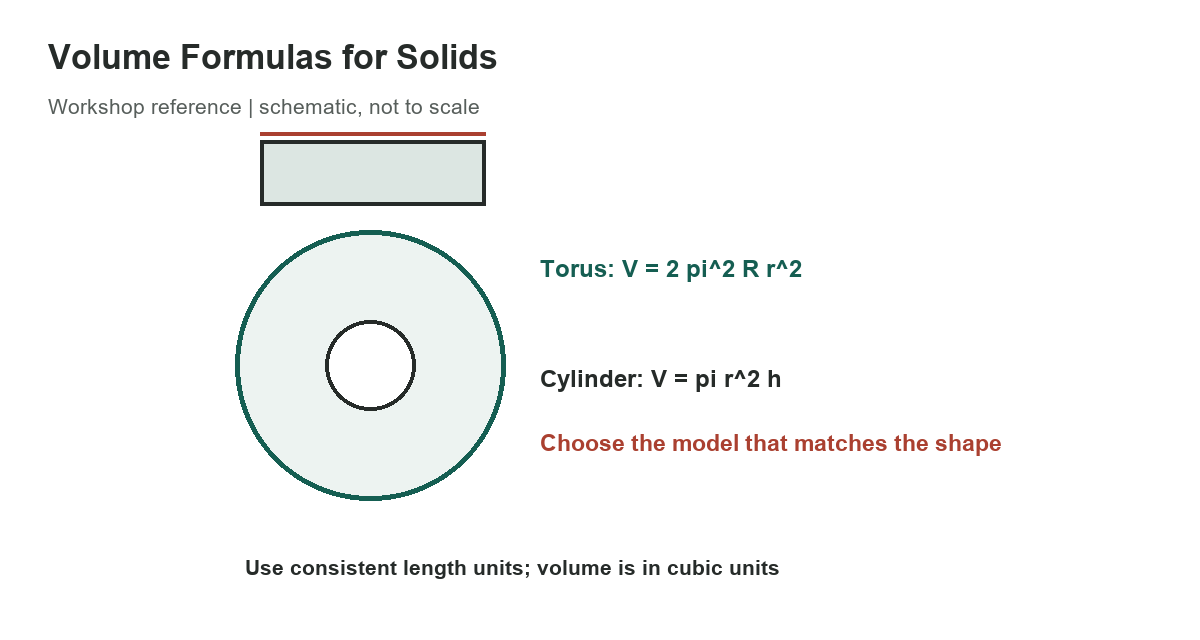
Use r for a circular radius and h for height. In the paraboloid segment, R and r are the radii of the two circular ends. For the torus, R is the distance from the ring centerline to the tube center and r is the tube radius. For the barrel approximation, D is the maximum inside diameter, d is the inside diameter at the ends, and h is the inside height or length along the axis.
Keep all lengths in the same unit before calculating. The result is in cubic units: inches produce cubic inches, millimeters produce cubic millimeters, and meters produce cubic meters. If a result is needed in liters, convert the cubic units after the calculation; do not mix an inch radius with a metric height.
Choose an exact model or an approximation
The cylinder, cone, and sphere equations are exact for their ideal geometric shapes. The paraboloid-segment equation is exact for a truncated paraboloid with coaxial circular ends. The torus equation describes a ring-shaped solid generated by revolving a circular cross-section around an axis outside that circle; the major radius must exceed the tube radius for a ring torus without self-intersection.
The circular-arc barrel equation is approximate. It assumes that the vessel’s side profile follows a circular arc and uses inside dimensions. A barrel with straight sides, a different bulge profile, thick heads, internal fittings, or nonuniform wall can have a different capacity. Use a manufacturer’s capacity chart or a measured fill test when a real container’s usable volume matters.
For a quick exact example, a right cylinder with r = 2 in and h = 5 in has V = pi times 2 squared times 5, or about 62.83 cubic inches. If the measured 4 inches was a diameter rather than a radius, the radius is 2 inches; using 4 as r would make the result four times too large. Always check whether a drawing labels radius or diameter.
Where the special formulas come from
The torus relationship can be derived with Pappus’s theorem: rotate a circular region of area pi r squared whose centroid travels a circumference 2 pi R. Multiplying those gives 2 pi squared R r squared. This also explains the required geometry: the axis of rotation must not pass through the disk region. OpenStax presents the theorem and a worked torus example.
Paraboloid and barrel formulas depend on how cross-sections change along the axis. A formula for a parabolic side profile cannot be substituted for the circular-arc approximation merely because both objects look like barrels. If a shape is irregular, use measured cross-sections or a suitable integral/model rather than forcing it into a standard equation.
Do not confuse geometric volume with usable capacity
These equations calculate ideal enclosed volume, not a safe fill limit. They do not account for wall thickness, head shape, minimum freeboard, trapped air, thermal expansion, structural pressure, or liquid expansion. A storage tank, pressure vessel, fuel container, or lifting component needs the manufacturer’s rated capacity and applicable engineering requirements.
For layout work, the equation is a starting point for estimating raw stock, a hopper, or a simple vessel. For purchasing or safety decisions, verify the actual inside dimensions and shape. The companion square and hexagon measurement reference covers cross-sectional geometry, the fractional-inch to decimal-feet chart addresses a unit conversion, and the shell-reamer arbor chart shows another workshop dimension reference.
References
OpenStax lists the standard cylinder, cone, and sphere formulas and explains Pappus’s theorem for volume. The handbook’s barrel equation is explicitly approximate; use measured capacity or a manufacturer drawing when a real vessel’s usable volume matters.