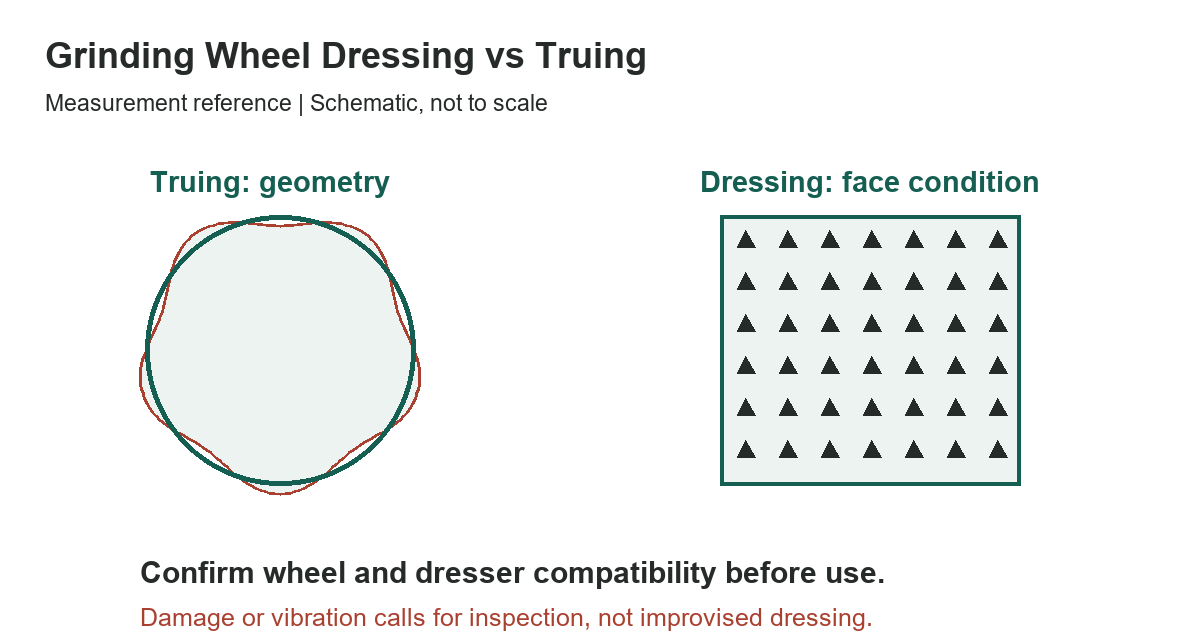
Truing and dressing address different aspects of a grinding wheel. Truing concerns the wheel’s geometry or profile and its relationship to the machine axis. Dressing concerns the grinding-face condition. They may be performed together on some systems, but a change in finish does not automatically tell you which operation or tool is appropriate.
Identify the exact wheel, grinder, and approved conditioning method before proceeding. This guide helps organize the checks; it is not a universal setup procedure. Do not try to dress away cracks, impact damage, abnormal vibration, or an uncertain mounting condition.
Start with the observed problem
The table distinguishes wheel geometry, face condition, and situations that require stopping. Its suggestions are diagnostic starting points, not proof that dressing is the correct repair. The complete machine, wheel, and work process must be considered.
| Incorrect profile or runout | Geometry and mounting require assessment | Truing may be relevant on an approved system |
|---|---|---|
| Loaded or glazed face | Face condition and wheel/material match | Compatible dressing may be relevant |
| Finish has changed | Check wheel condition and the complete process | Do not choose a dresser from finish alone |
| Crack, impact damage or abnormal vibration | Stop and inspect; follow replacement requirements | Dressing is not a repair for damage |
| Diamond, CBN or special bond | Exact wheel and conditioning instructions | Do not transfer a conventional-wheel method |
| Worn or unsuitable dressing tool | Tool condition, fixture and compatibility | Correct the tool/setup before proceeding |
6 rows
Scroll horizontally to view all columns.
Truing concerns shape and running geometry
A truing operation can restore or produce a required wheel profile on a system designed for that operation. The task depends on the geometry required, the wheel construction, the available equipment, and the approved tool. It should not be treated as a general instruction to reshape any abrasive product.
If a wheel appears to run incorrectly, first resolve whether its condition, mounting, or machine requires attention. A geometric error is not established as harmless simply because material could be removed from the rim. Follow the inspection and replacement requirements rather than masking a mechanical problem.
Dressing concerns the cutting face
A wheel’s working face can change during use. Norton distinguishes refreshing the face condition from restoring profile. That distinction helps explain why a wheel can have an apparently correct shape yet still not produce the intended result.
However, face appearance alone does not establish a complete diagnosis. Work material, wheel specification, process settings, and the conditioning tool all belong in the review. Record what changed and compare it with the documented process instead of repeatedly applying a more aggressive dressing action.
Choose the tool for the actual wheel and system
Dressing tools include different diamond arrangements and other conditioning products. Their appearance or price is not enough to determine compatibility. Norton identifies wheel size, bond, abrasive type, and the required profile among the considerations involved in tool selection.
Use the exact wheel and tool instructions, including their intended machine and support arrangement. A method for a conventional bonded wheel should not be transferred unchanged to diamond, CBN, or another special product. Do not assume a handheld bench-grinder dresser is suitable for a precision machine or vice versa.
Support, access, and adjustment need planning
Before operation, confirm how the approved tool is held and supported. Make the required setup adjustments with the machine safely isolated as instructed. Keep guards and required protective equipment in the planned arrangement rather than removing them to gain an easier approach.
CCOHS emphasizes supporting dressing tools and avoiding adjustments while bench-grinder wheels are moving. The precise setup belongs to the product instructions and training for that machine. This page intentionally does not provide a universal dresser angle, depth per pass, traverse speed, or tool-rest setting.
Inspect the dresser as well as the wheel
A worn, loose, damaged, or unsuitable conditioning tool can prevent the intended result. Record the tool identification and condition before changing the grinding process. Do not keep compensating for a questionable tool by increasing force or removing more wheel material.
If the tool’s permitted use is unclear, obtain guidance from its maker or the wheel supplier. Where a process depends on a specific fixture or controlled movement, an improvised holder is not shown to be equivalent merely because it can touch the same part of the wheel.
When to stop instead of conditioning
Stop for cracks, impact damage, unexpected vibration, uncertain ratings, or a mounting concern. Dressing is not a repair for a damaged abrasive wheel. Keep the equipment out of use until the cause has been assessed and the required corrective action completed.
A recurring finish problem also deserves a broader process review. Keep notes on the wheel, work material, approved settings, conditioning tool, and results. That record is more useful to a supplier than a request for a more aggressive dresser without the surrounding context.
Before choosing a method
- Separate profile concerns from face-condition concerns.
- Identify the complete wheel and machine specifications.
- Inspect the approved tool, fixture, and support arrangement.
- Follow the documented procedure and training for the exact system.
- Treat damage or vibration as a stop-and-inspect condition.
For stationary-shop planning, see garage workbenches and workbench space considerations. The reference library covers related measurements.
References
Read Norton’s truing and dressing explanation, its tool-selection discussion, and CCOHS bench and pedestal grinder guidance. Use the manufacturer’s instructions for the actual operation.