Use this lookup when a fractional-inch measurement needs a millimeter value for a drawing, inspection note, or tool setup. It covers every 1/64-inch increment from 1/64 through 1/2 inch. The values are calculated from the exact definition 1 inch = 25.4 millimeters, then displayed to six decimal places.
How to read the lookup
The first column keeps the common fraction, the second gives its decimal-inch equivalent, and the third shows millimeters. For example, 1/8 inch is 0.125000 inch and 3.175000 mm. A 3/8-inch measurement is 0.375000 inch and 9.525000 mm. The decimal-inch column helps if a caliper or digital readout displays a decimal rather than a fraction.
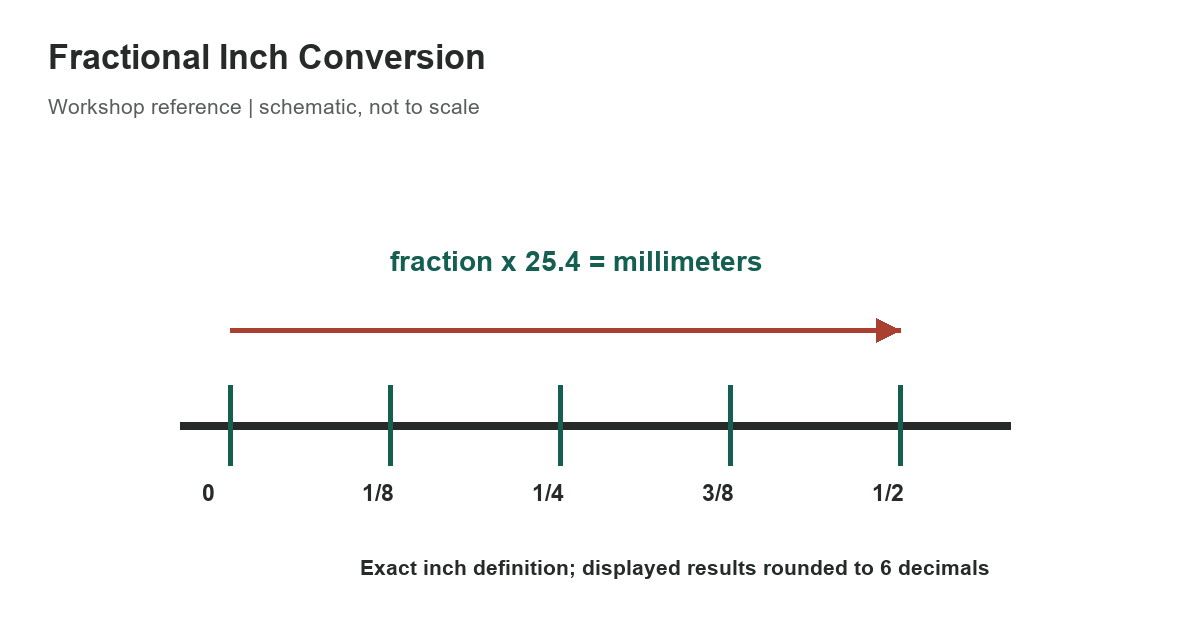
The conversion itself is straightforward: divide the fraction’s numerator by its denominator to get inches, then multiply by 25.4. For 7/32 inch, 7 divided by 32 is 0.21875 inch; multiplying by 25.4 gives 5.55625 mm. The displayed value is exact to the shown decimal places for these fractions because the denominator is a power of two and the conversion factor is exact.
[gs_table id=”11105″]
Keep conversion separate from tolerance
Unit conversion changes how a length is expressed; it does not change the measurement’s uncertainty or the part’s tolerance. If a drawing specifies 3/8 inch with a tolerance, convert both the nominal dimension and the tolerance using the same unit factor. Keep the source units in the inspection record so another person can tell whether a value was measured in inches or millimeters.
Do not round an intermediate calculation more than necessary. For example, using 0.22 inch instead of the exact 7/32 value changes the calculated metric result. When a drawing or standard gives a rounded conversion, follow its stated precision. This table displays six decimal places for convenience; it is not a claim that a shop measurement is accurate to a millionth of a millimeter.
The earlier inch-to-metric conversion-factor guide lists common unit factors such as inches to millimeters and feet to meters. The fractional-inch to decimal-feet lookup expresses small inch fractions as feet instead. For a larger combination dimension, see the feet-and-inches conversion chart. Each reference answers a different unit-conversion task.
When the table is not enough
This range stops at 1/2 inch because it is designed as a common fractional-shop lookup, not a complete unit-conversion handbook. The same equation works for other fractions or mixed numbers. Convert a mixed number by adding its whole-inch and fractional-inch parts before multiplying by 25.4. For example, 1 3/8 inches is 1.375 inches, or 34.925 mm.
For close-tolerance work, use the drawing’s unit system and the correct measuring instrument. Consider temperature, instrument resolution, calibration, surface finish, and the method used to locate the endpoints. A converted number cannot make an imprecise measurement more precise. If a contract or inspection standard specifies a rounding rule, that rule takes precedence over the display precision here.
For values between two rows, calculate from the actual fraction instead of interpolating between rounded display values. The conversion factor is linear, but rounding at each intermediate step can accumulate error. Keep the unrounded decimal through the calculation and round only the final reported result to the precision required by the drawing or inspection plan.
NIST states that the inch is exactly equivalent to 25.4 mm. All entries in this table are derived from that factor rather than copied from a pre-existing conversion chart. The decimals help with lookup, but the underlying relationship remains the exact unit definition.
References
- NIST’s SI length reference states the exact inch-to-millimeter relationship used for the calculations.
- Industrial Press identifies the handbook edition containing the historical comparison table reviewed for this topic.