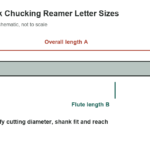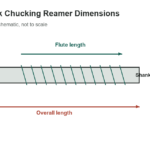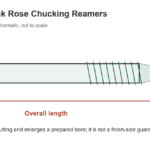
Tool dimensions affect whether a cutter fits the holder, reaches the work and clears nearby fixtures. The selected rows below distinguish overall length from shank length and shank diameter. These dimensions are not interchangeable: a long overall tool may still have a shorter usable shank, and the cutting diameter does not identify the shank needed by a collet or holder.
[gs_table id=”11197″]
Read the dimension letters consistently
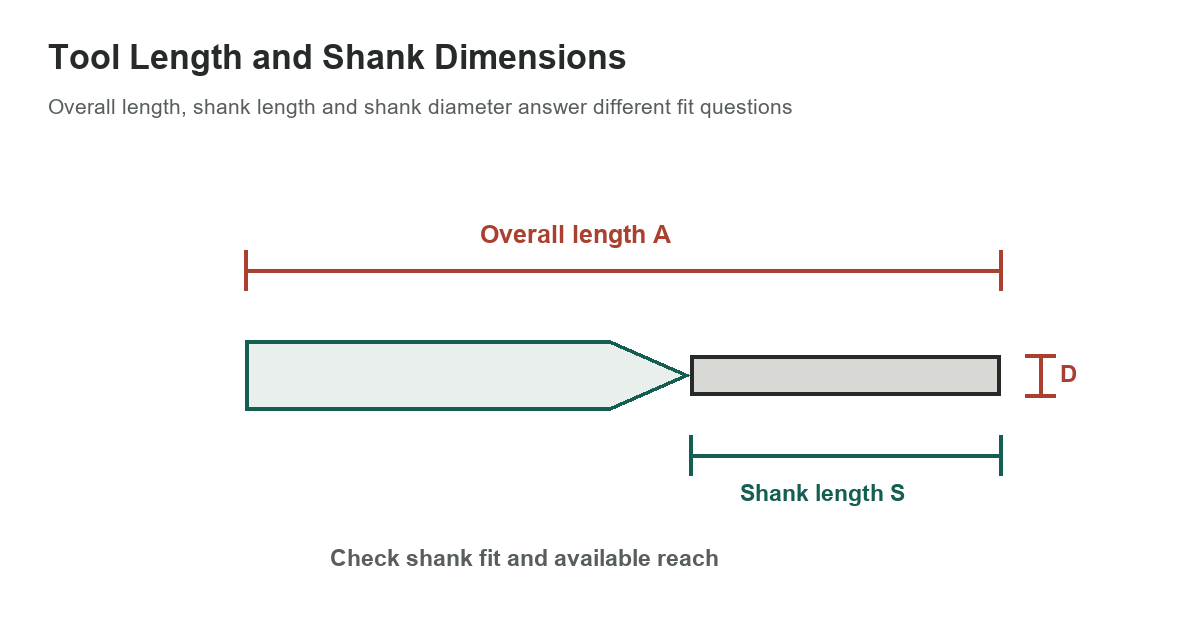
In this reference, A is overall length, S is shank length and D is shank diameter. The cutting diameter describes the working end. Use the drawing associated with the specific tool family to confirm every letter before comparing a catalog listing. Dimension letters can differ between standards and manufacturers; never transfer a letter definition from a visually similar drawing without checking it.
Shank diameter is the first holder-fit check. Compare it with the holder’s stated capacity and tolerance, and confirm whether the holder is designed for a straight shank, a specific collet system or another interface. A nominally matching diameter does not by itself establish runout, grip length or suitability for the cutting load. Do not force an oversized tool into a holder or assume a smaller shank is acceptable without the maker’s guidance.
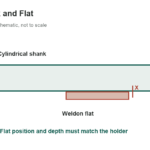
For a practical fit check, identify the holder model and its usable clamping range, then measure the tool shank with an appropriate instrument. Check that the gripping length is sufficient and that the cutting portion will not be trapped inside the holder. Inspect the shank for flats, damage, burrs or coatings that affect clamping. When a tool is held in an adapter, consider the adapter’s total projection and the machine’s available travel rather than judging reach from the tool length alone.
Check reach and clearance separately
Shank length and overall length help estimate how the tool can be held and whether it can reach the feature. Measure the required reach from the actual spindle or holder reference point to the cutting location. Account for the holder nose, fixture, workpiece geometry and any required clearance. Excessive stickout can reduce rigidity and increase deflection or chatter; use the shortest projection that provides safe access.
The center reamer and machine countersink examples are different tool types, not a single interchangeable series. Their selected diameters illustrate how overall length and shank proportions vary. The historical values are useful for identifying an approximate size family, but they do not replace the exact current tool drawing. Manufacturers may revise dimensions or offer multiple constructions under a similar product name.
Choose the cutting operation, not just a diameter
A center reamer creates or finishes the intended center feature; a machine countersink prepares a conical seat or chamfer. Confirm the included angle and intended fastener or center standard separately. A countersink’s cutting diameter does not tell you the finished depth for a particular screw head. For that calculation, use the countersink depth and angle guide, which addresses the geometry rather than shank fit.
Before ordering, compare the part number, material, flute arrangement, cutting geometry, shank interface and length with the machine setup. If a drawing gives tolerances, use those rather than treating rounded chart values as inspection limits. Also verify the work material, cutting conditions and coolant guidance in the tool maker’s application data.
Use the chart as a screening reference
These selected rows are not a complete catalog. They help narrow a search and prompt the right fit questions; they do not certify a tool for a particular machine. For hole-making context, see the drill-point length reference and the reamer selection guide. Those pages cover adjacent decisions and do not change the dimensions shown here.
The center-reamer dimensions are selected from Alvord-Polk’s 179-0 catalog; the machine-countersink dimensions are selected from KEO’s catalog. These are catalog examples from separate tool families, not a single standardized series. Confirm the angle, exact part number, shank and current drawing before ordering or inspection.
Catalog dimensions: Alvord-Polk 179-0 center reamers and KEO machine countersinks.