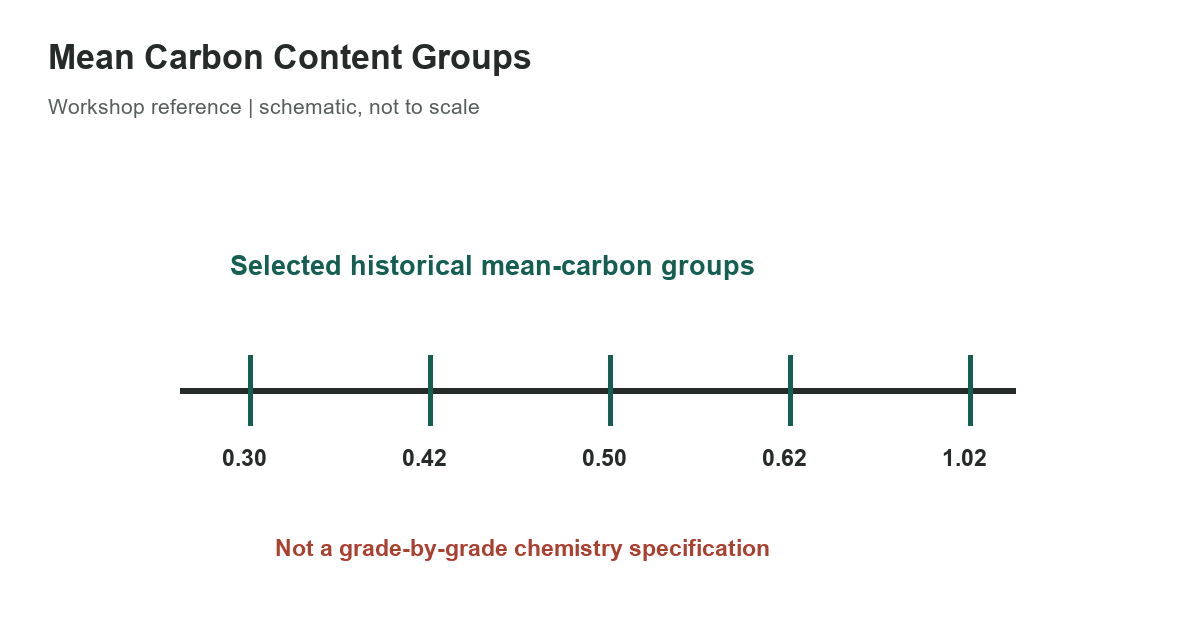
Carbon content is one clue to how a steel may respond to heat treatment, but a percentage alone does not identify a grade or determine a finished part’s performance. This chart summarizes five mean-carbon groups from a 2020 handbook discussion of SAE steel specifications and the broad applications associated with those groups. It is an educational historical classification, not a material-selection standard.
[gs_table id=”11084″]
What the percentages describe
The first four entries are bands of mean carbon content; the last is a single value shown by the source. The associated notes describe broad application classes such as heat-treated parts, springs, tools, and bearings. They do not specify a particular alloy designation, heat-treatment cycle, hardness, tensile strength, or allowable stress.
For example, the 0.50-0.62 percent group is associated in the historical table with springs and hand tools. That is not a recommendation to make a spring from any steel whose measured carbon falls in that range. Alloying elements, section size, cleanliness, processing, heat treatment, and the part’s design all affect suitability.
The letter labels in the original source are classifications, not SAE grade numbers. The same average carbon group can include steels with different alloy contents and hardenability. The adjacent text explains that alloy steels may be grouped by hardenability and that carbon-molybdenum steels can be handled differently. This is one reason a short carbon band cannot stand in for a full material specification.
Check the actual grade specification
SAE J403 is the current SAE reference for chemical compositions of SAE carbon steels. SAE explains that its current plan uses cast or heat-analysis ranges with product-analysis allowances, rather than relying on the older fixed ranges and limits. That means an old mean-carbon summary should not be used to accept material or to infer a current grade chemistry from a single percentage.
When selecting or identifying stock, use the exact grade and product form on the mill test report or supplier certificate. Check the current SAE designation, applicable specification, heat-treatment condition, and relevant mechanical properties. A material certificate’s chemistry is not a substitute for confirming the intended condition or the design requirements.
Carbon is not a strength rating
More carbon can support higher hardness after an appropriate heat treatment, but it can also change toughness, weldability, machinability, and cracking risk. A steel’s response depends on its full composition and process history. Two bars with similar carbon readings may not behave alike if one is alloyed, decarburized, cold-worked, or heat-treated differently.
Do not use the table to choose a safety-critical shaft, spring, fastener, pressure component, or bearing. Do not weld or heat treat an unidentified part based on a color or spark test. Ask a qualified materials engineer or the steel supplier when the grade, condition, or service requirements matter. The source’s application descriptions are broad historical notes, not engineering approval.
For a purchase, write the full material designation and condition on the requisition instead of specifying only “medium carbon” or a percentage. For an existing part, preserve its marking and traceability where possible. A handheld analyzer can help identify chemistry, but it may not report every element needed to distinguish similar grades or confirm the required mechanical condition.
Weldability and heat-treatment response are especially sensitive to the complete chemistry and part thickness. Carbon equivalent calculations, preheat requirements, quench practice, and postweld treatment belong to the applicable material and procedure guidance; the five broad groups here do not supply those values.
Related metalworking references
For workshop decisions involving dissimilar metals, see the galvanic-corrosion compatibility guide. The metalworking-fluid comparison covers process fluids rather than steel chemistry. For workholding context, the bench-vise guide compares a different part of a metalworking setup. None of these pages replaces a grade-specific specification or a mill certificate.
References
The mean-carbon groups are historical summaries from the handbook’s 2020 edition. Current SAE J403 defines grade-specific chemical composition ranges and refers to product-analysis allowances. Use the exact grade designation, current specification, and mill certificate when identifying or buying steel.