Copper water-tube size labels are nominal. The outside diameter is standardized separately, while the inside diameter changes with tube type because wall thickness differs. This selected lookup compares Type K, L and M inside diameters at four common nominal sizes. It is a dimensional reference only, not a pressure-rating chart.
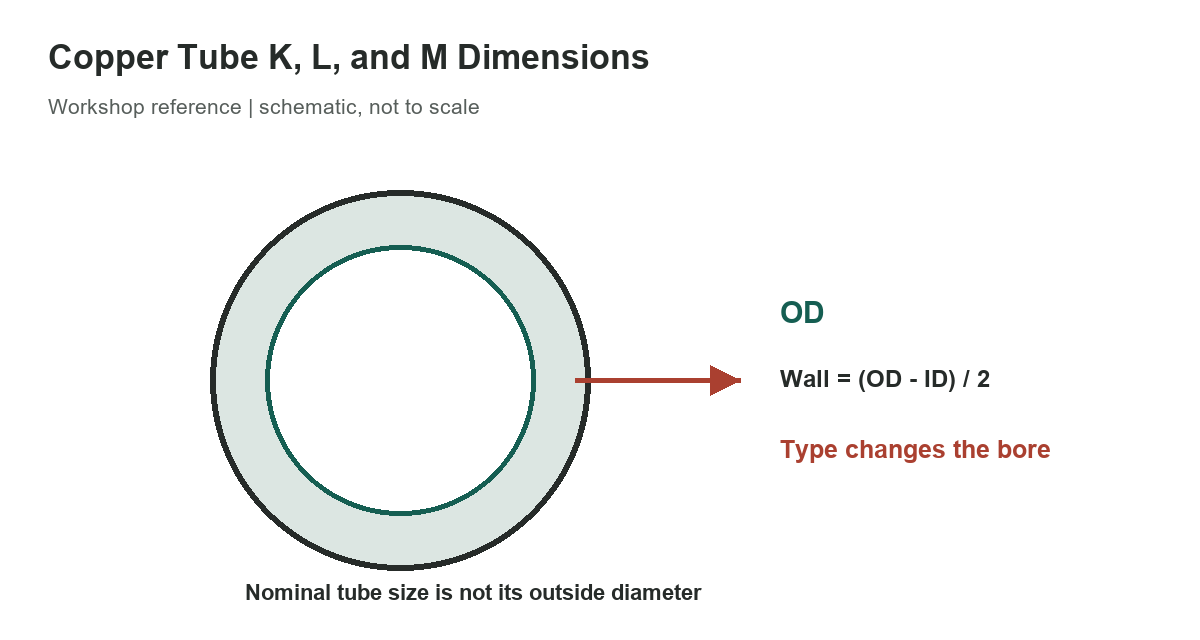
Read nominal size and actual diameter separately
For these ASTM B88 water tubes, the nominal size does not equal the outside diameter. A nominal 1/2-inch tube has an outside diameter of 5/8 inch. Type K has the thicker wall among K, L and M, Type L is intermediate, and Type M is thinner. At a given nominal size, that makes the listed bore largest for M and smallest for K.
The table shows selected inside-diameter values from the Copper Development Association’s current handbook dimensions and the matching historical source page. The diameter values are rounded to three decimal places as published. Confirm the marking on the actual tube and the current mill data before selecting fittings or calculating flow.
[gs_table id=”11055″]
Use inside diameter for flow calculations
When estimating cross-sectional area, use the actual inside diameter rather than the nominal size. For a circular bore, area is π times the square of the inside diameter divided by four. A small diameter difference can make a meaningful change in area because the diameter is squared. Flow capacity also depends on length, fluid, temperature, roughness, fittings, pressure drop, and the system design criteria.
For example, the nominal 1/2-inch entries range from 0.527 inch for Type K to 0.569 inch for Type M. That difference changes the theoretical bore area, but it does not establish a safe flow rate or permitted working pressure. Use the appropriate technical manual, engineered sizing method, and local code for the service.
Keep tube families and standards distinct
This chart covers selected Type K, L and M copper water tubes associated with ASTM B88. DWV drainage tube, ACR refrigeration tube, and medical-gas tube have different product standards, markings, dimensions, cleaning requirements or applications. Do not transfer the K/L/M dimensions to one of those products based only on a similar nominal label.
Type K, L and M are wall-thickness designations, not interchangeable pressure classes. Temper, joining method, temperature, corrosion conditions, design code and fitting limits all affect system suitability. A dimensional chart cannot establish an allowable pressure. For pressure selection, use the current manufacturer data and the governing code with the correct tube type, temper and joint.
Check the tube before ordering or measuring
Read the continuous manufacturer identification and tube-type mark. Confirm whether the tube is drawn or annealed, straight length or coil, and whether the dimensions are stated as nominal, actual, minimum or calculated. A caliper reading at one point may be affected by ovality, a cut end, burrs or measurement force. Use an appropriate method and the specification tolerance for acceptance inspection.
For a clearance fit, compare the actual outside diameter with the fitting’s intended tube standard and size. For a flow calculation, use the actual inside diameter for the correct type and temper. Do not choose an adapter or fitting by nominal labels alone when the product families differ.
The four rows are examples rather than a complete size schedule. Obtain the latest standards and supplier tables for sizes not shown, and confirm local plumbing and mechanical requirements before installation.
Related guides: copper tube types and applications, natural-gas pipe sizing limits, and low-pressure propane pipe sizing.
Source and scope
Selected dimensions were cross-checked against the Copper Development Association’s Copper Tube Handbook, Tables 14.2a-c, which publishes the physical characteristics of Types K, L and M. The CDA identifies the distinct standards and applications for other tube families. This table intentionally omits calculated working pressures and burst values. Copper Tube Handbook; CDA tube properties; CDA tube and pipe standards.