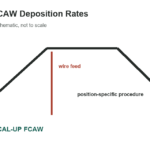
Flux-cored arc welding deposition rate depends on the wire formulation, diameter, current, voltage, wire-feed speed, shielding gas, contact-tip-to-work distance and position. A rate copied from one wire cannot be treated as a universal FCAW setting. The examples below are manufacturer data points for named products; consult the current data sheet before choosing a wire or setting.
Selected manufacturer data
The table keeps each value attached to its product and stated setup. ESAB publishes rates for particular gas-shielded wires, and its Dual Shield T-75 values show how the rate changes with the operating point. Shield-Bright 309L X-tra is a stainless flux-cored wire with its own diameter and operating ranges. These products are not interchangeable merely because both use FCAW.
[gs_table id=”10829″]
Read the operating conditions first
Before comparing rates, confirm whether a wire is gas-shielded or self-shielded, its AWS classification, base-metal compatibility, polarity and approved welding positions. Confirm shielding-gas composition and flow, wire diameter, current, voltage, wire-feed speed and stick-out or contact-tip-to-work distance. Each factor can change arc behavior and deposition. Do not use a table’s maximum rate as a recommended setting if the machine, joint or product data sheet does not support it.
Deposition rate describes deposited filler metal over time under a stated test or operating condition. It is not the same as completed weld length per hour, arc-on efficiency or production throughput. Fit-up, joint volume, position, starts and stops, cleaning, inspection and operator technique affect the time needed to finish a weld. A high deposition number alone says little about fusion, penetration or weld quality.
Flat and horizontal are different positions
A flat weld is deposited from above on a surface oriented to keep the weld pool supported. A horizontal weld is made on a vertical surface with the weld axis horizontal, so gravity influences the pool differently. A wire classified for all-position use may support more positions, but a manufacturer’s rate chart can still be limited to particular positions or procedures. Read the exact product notes instead of assuming that flat and horizontal settings transfer to vertical or overhead work.
Use qualified welding procedures and the governing code when required. For structural, pressure-retaining, lifting or safety-critical work, wire selection and parameters must follow the approved procedure and applicable qualification. A product page or quick reference is not a WPS, and the values shown here are not procedure qualification data.
Use the chart as a comparison aid
For a planning estimate, identify a candidate wire and compare only rows that share compatible diameter, gas and position conditions. Confirm the machine’s duty cycle and available current, then review the manufacturer’s full operating window and classification. Record the source and revision with the job plan. If a rate seems far outside a comparable product’s range, check unit conversion, diameter, gas and whether the number is melt-off rate or actual deposition rate.
The T-75 examples illustrate the difference between operating points: the listed current rises from 450 A to 500 A while the published deposition rate rises from 8.0 to 10.3 kg/h. That comparison applies to the named wire and its documented setup, not to every 3/32-inch flux-cored electrode. The Shield-Bright ranges belong to a different stainless product and cannot be substituted into a mild-steel procedure.
Manufacturers may publish typical values, recommended parameter ranges or test results using different methods. Read footnotes and table headings to determine which one is being shown. Keep both metric and customary values attached to their original row, and avoid false precision when the source rounds conversions. If a current data sheet conflicts with an older catalog or third-party summary, use the current manufacturer document and ask the technical representative to resolve the discrepancy.
For related shop references, see the garage equipment and workshop guides, browse the size-chart library, and compare the benchtop drill-press guide.
Sources
ESAB product data provides the named-wire deposition examples and their operating context. Lincoln Electric’s FCAW-G technical sheet is an additional manufacturer reference for how rates are tied to specific wire and operating procedures. Manufacturer data and qualified procedures take precedence over generic charts.