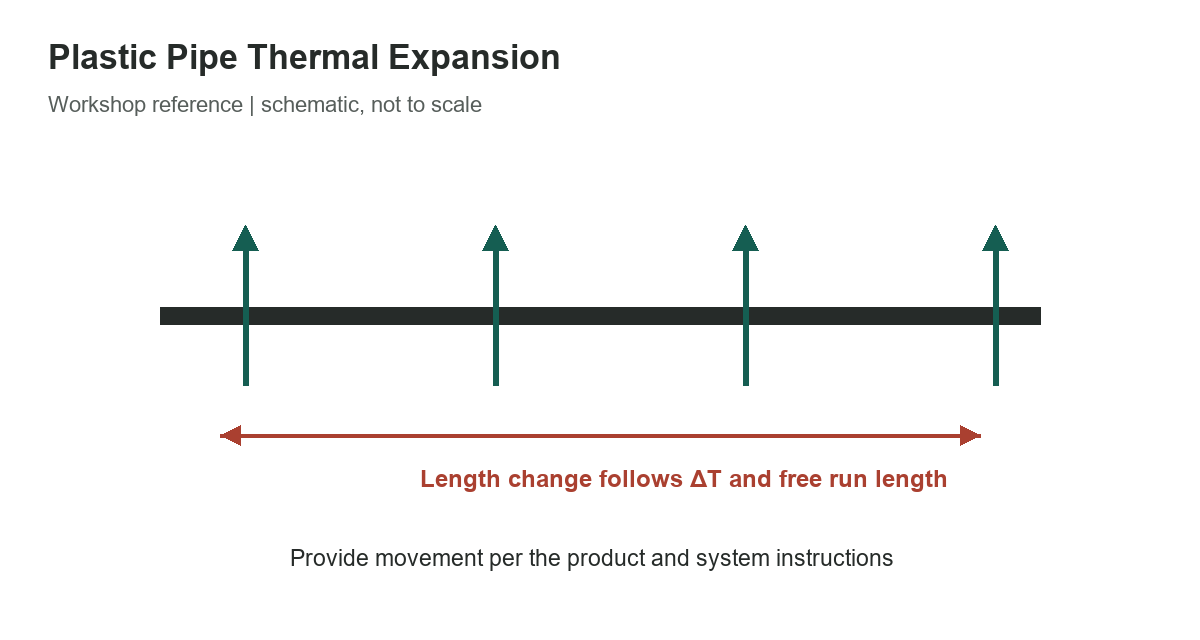
Plastic pipe changes length as its temperature changes. The amount depends on the pipe product, temperature difference and free run length. This reference uses selected expansion factors from Charlotte Pipe’s Plastics Technical Manual and calculates movement for one stated example. It does not make the coefficients universal across every resin, formulation or pipe brand. For related plumbing and air-system references, see our PEX tubing chart, propane pipe sizing guide, and compressed-air pipe chart.
Selected coefficients and example movement
The example holds the run length at 60 feet and the temperature change at 50°F. The coefficient is expressed as inches of length change per 10°F per 100 feet of pipe. Results below are calculations from those inputs, rounded to three decimal places.
[gs_table id=”10937″]
Calculate a different run
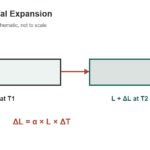
Using the manual’s units, ΔL = Y x (ΔT/10) x (L/100), where ΔL is length change in inches, Y is the selected coefficient, ΔT is the temperature difference in degrees Fahrenheit, and L is the straight run length in feet between directional changes. For 60 feet of PVC and a 50°F change, ΔL = 0.360 x 5 x 0.6 = 1.08 inches.
Use the greatest relevant difference between installation temperature and the system’s maximum or minimum temperature. Expansion and contraction have opposite directions, but both can place stress on joints and supports when movement is restrained. Record the installation temperature and the expected operating range rather than assuming the pipe starts at room temperature.
Match the data to the actual product
The coefficients in this chart are tied to Charlotte Pipe’s stated ABS, ABS Plus, CPVC and PVC product information. A different resin, grade, reinforcement, pipe construction or manufacturer may publish a different value. Vinidex, for example, gives a PVC expansion coefficient in metric units and discusses how installation conditions affect movement. Always use the current manual for the exact pipe system and jurisdiction.
Temperature movement is only one installation consideration. Support spacing, anchors, guides, direction changes, expansion loops, pressure and temperature ratings, chemical compatibility, joining method and applicable plumbing code all matter. Do not treat a calculated loop length or free movement estimate as a complete installation design.
Use the straight length between points that constrain or redirect the pipe, consistent with the product manual’s definition. A long run divided by frequent direction changes may not behave like one uninterrupted span, while an incorrectly placed anchor can concentrate movement at a joint. Confirm where fixed points and guides belong before calculating an offset or loop, and account for the system’s full temperature cycle.
The example is a free length-change calculation, not a prediction of how much pipe will actually move after restraints, supports and friction are installed. In a constrained system, thermal movement produces force and stress that depend on the support arrangement and material response. A piping professional should check the system design, especially where movement can load a valve, equipment nozzle, threaded connection or building penetration.
Allow movement safely
Charlotte Pipe warns against restraining movement and describes supports that permit pipe movement. Follow the product manual’s directions for hangers, guides, offsets and expansion loops. Do not pull a solvent-welded assembly into position or force a fitting under stress. A run that terminates against a rigid wall or joist can transfer movement into a joint or fitting.
For concealed, hot-water, industrial or otherwise safety-critical installations, confirm the design with a qualified plumbing or piping professional and follow the adopted code. This chart is a calculation aid only. It does not establish allowable pressure, temperature suitability, support layout or regulatory compliance.
Sources
Charlotte Pipe’s Plastics Technical Manual defines the selected coefficients, units and movement formula. Vinidex’s PVC temperature guidance provides a separate metric example and installation context.