Stainless tube pressure figures are not interchangeable across products. The values below are a selected example from Parker’s Phastite connector catalog for one tube outside diameter, specific wall thicknesses and 316 stainless seamless tubing. They describe a named tube-assembly application, not a general rating for every tube, fitting or fluid system.
Selected Parker Phastite ratings for 12 mm tube
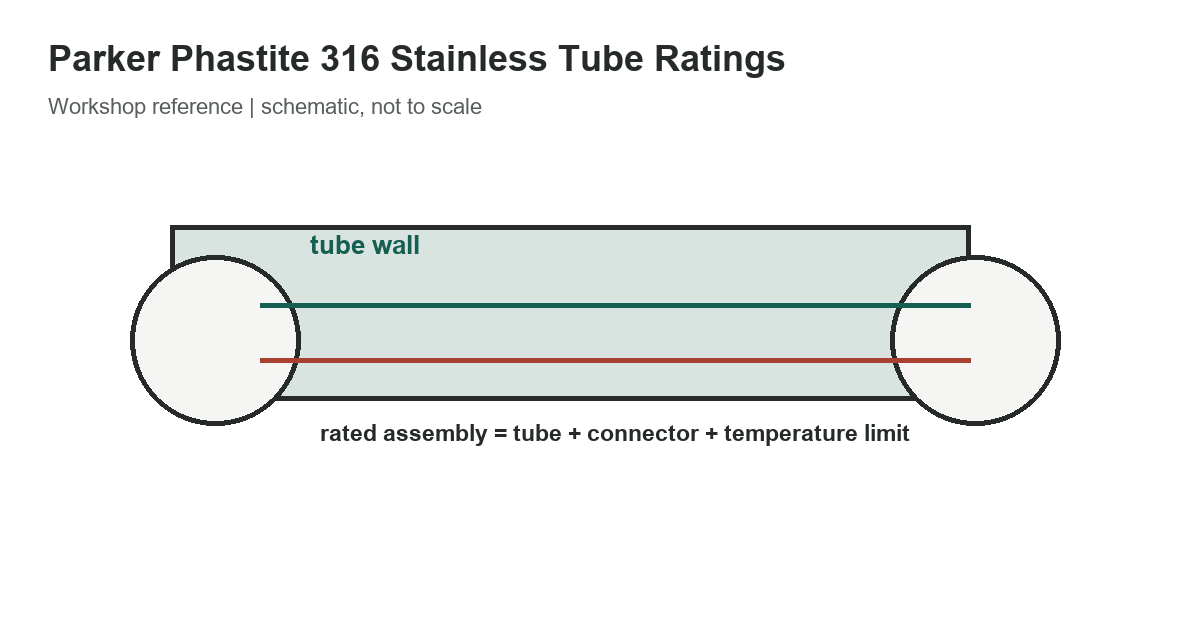
Each row is the catalog’s maximum tube-assembly rating for the listed tube wall thickness in the 12 mm size row. The catalog states that its tables cover 304 or 316 stainless seamless tube to 93 C (200 F); the maximum product pressure is also a separate cap. Check the current complete catalog and the exact connector model before use.
[gs_table id=”10983″]
Why a thicker wall changes the listed value
For the same 12 mm outside diameter, the cited catalog lists higher maximum assembly ratings as wall thickness increases. This is a product- and code-method-specific calculation under the catalog’s assumptions, not permission to substitute arbitrary tubing. Tube material, outside diameter, manufacturing route, wall tolerance, temperature and connector compatibility all affect the result.
Parker’s catalog describes these values as maximum tube assembly ratings and states that working pressure ratings for stainless tubing are derived from stress values and methods in ASME B31.3. It also sets product limits for the Phastite connection itself. The allowable system pressure is constrained by the weakest applicable component and any governing code or project requirement; the table alone cannot approve an installation.
Temperature and manufacturing route matter
The selected rows are within the catalog’s stated temperature scope of up to 200 F (93 C). Do not extrapolate them above that range. At elevated temperatures, allowable stress changes, and the complete manufacturer procedure may apply a material-specific temperature factor. A weld seam can also require a derating factor; the catalog gives separate factors for single- and double-welded tubing. This table is specifically for seamless tube and should not be applied to welded tube.
Corrosion, erosion, vibration, cyclic loads, external loads, fluid chemistry and installation damage are not resolved by a pressure number. The catalog emphasizes proper selection and installation; the actual connector, tube end preparation and assembly process have to match Parker’s documented practice. A fitting with a different design or a different brand may use different pressure limits.
Check the complete assembly before design use
Confirm that the tube is 316 stainless and meets the cited product’s dimensional and material requirements. Measure outside diameter and wall thickness using an appropriate method, identify seamless versus welded construction, and verify the connector family. Check the operating temperature and any transient or cyclic conditions, then apply the adopted piping code, the manufacturer’s installation instructions and the responsible engineer’s review.
Pressure ratings can be gauge or absolute and can be affected by test basis, fluid, temperature and system configuration. Confirm the meaning of the rating in the current catalog. Do not use the highest number in a table simply because one component appears to support it. The connector, tubing, valve, instrument, seals and downstream equipment all need compatible ratings for the service conditions.
Do not use legacy generic charts as a system rating
The handbook page that prompted this topic contains an older selected-size chart plus a thin-wall formula and broad safety-factor discussion. Those values are not a current specification for a modern connector system. This article therefore uses a limited manufacturer example rather than reproducing the old chart or presenting its Barlow equation as a universal allowable pressure method.
Where the application is safety-critical, high-pressure, corrosive or regulated, have the complete tubing system reviewed by a qualified engineer using the current adopted code, current manufacturer literature and documented material traceability. If the exact tube or fitting is outside the product catalog scope, contact the manufacturer rather than interpolating this small selection.
Fast verification checklist
Before relying on a rating, match the outside diameter, wall, material grade, seamless or welded process, connector type, installation procedure, temperature and pressure basis. Confirm that the catalog revision is current and that the complete assembly falls inside its conditions. Record the source and revision with the design calculation, and recheck whenever a component or service condition changes.
Related references: exact inch-to-metric length relationships, rose chucking reamer dimensions, and ribbed-neck bolt dimensions. Each covers a separate shop-reference task.
Source and limits
Values are transcribed from Parker’s Phastite Tube Connectors catalog MC08, metric pressure table, 12 mm tube row. The catalog limits the referenced ratings to specified 304/316 seamless tubing up to 93 C and separately identifies connector product limits and welded-tube derating. This extract is not engineering approval.