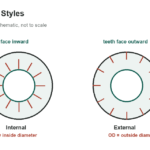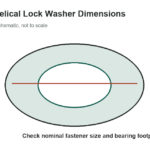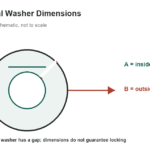
A countersunk external-tooth lock washer combines a conical bearing face with teeth around its outside edge. It is intended to sit beneath a matching countersunk fastener head; it is not the same part as a flat external-tooth washer. The selected dimensions below cover that conical external-tooth style in inch-series sizes.
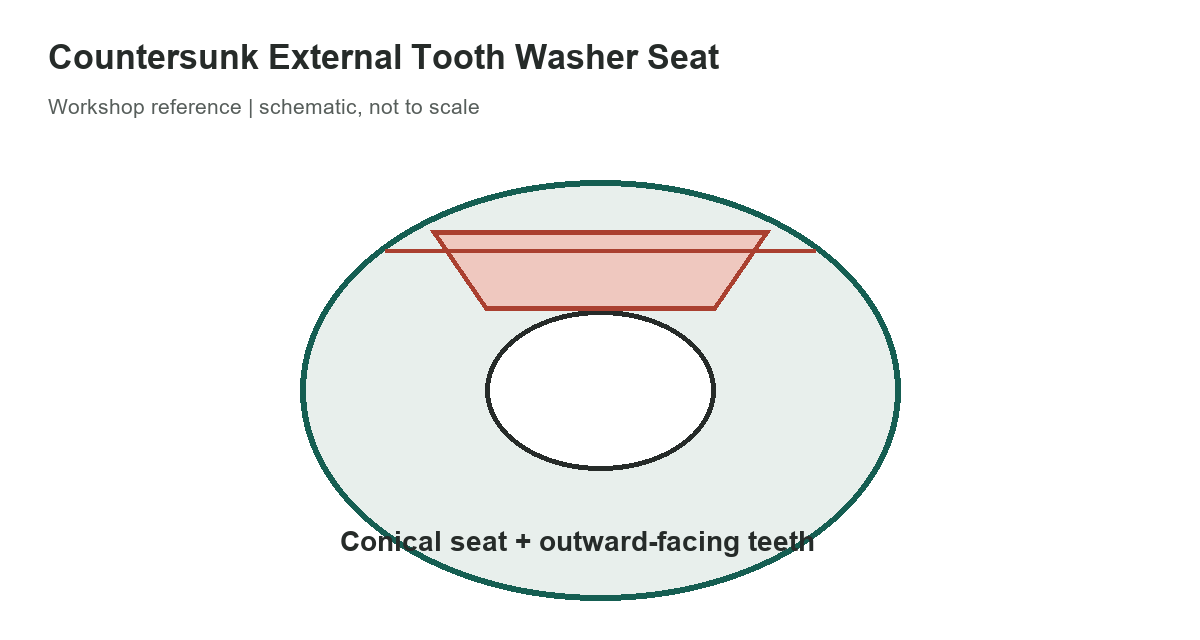
Selected countersunk external-tooth sizes
Inside diameter and thickness are shown as minimum-to-maximum ranges. Outside diameter is the approximate value listed by the supplier. Countersink length is also a range; it is not the head angle. Values are selected from the ASME B18.21.1 dimensional family and one current supplier guide.
[gs_table id=”11159″]
Check the mating head and seat
The conical washer surface is intended for flat- or oval-head screws with an 82-degree or 100-degree countersunk seat, as listed by the supplier. Verify the exact head angle, washer orientation, inside-diameter clearance, and available outside envelope. A matching nominal screw size alone does not ensure that the cone seats correctly. If the head rocks, bottoms on the hole, or bears only on an edge, the joint geometry is not a proper match.
Countersunk washers can help provide a formed bearing interface where a flat washer would not seat flush, but their presence does not establish a joint’s resistance to loosening. Tooth engagement depends on the materials, surface finish, coating, clamp load, and geometry. Do not treat a washer as a substitute for the specified locking method, a suitable fastener, or correct assembly torque.
Dimensions may vary in presentation across standards and suppliers. The selected table reports the maximum and minimum values available in the referenced supplier table; it is not a complete reproduction of ASME B18.21.1 and does not include every material, finish, or size. Confirm the current product drawing and standard revision before specifying a part. Where a drawing controls, use its dimensions and tolerance block instead.
The approximate outside diameter is useful for checking clearance, but the conical seat needs its own fit check. Compare the included angle and bearing geometry of the washer with the fastener head and the prepared countersink. A washer can have adequate inside clearance yet still fail to sit flush if its cone is too shallow, too deep, or otherwise mismatched. The listed countersink length is a dimensional callout, not an angle conversion.
To distinguish this style from other washer families, our internal, external, and combination tooth-washer chart covers flat washers without a countersunk cone. The high-collar helical spring-lock washer chart and regular-section helical washer chart describe split-ring styles, not toothed countersunk washers.
Installation also depends on the surface beneath the washer. Teeth may mark a finish or coating, and a soft substrate can deform under concentrated contact. Check whether the assembly permits that contact and whether the design calls for a hard washer, a different finish, or another locking feature. The table contains no torque or load rating, so it cannot determine clamp force or joint performance.
When comparing sizes, use the inside diameter, outer envelope, thickness, and cone dimensions together. Do not select a part from the nominal screw size alone or substitute the approximate outside diameter for a countersink drawing dimension. If a supplier’s product sheet differs, follow the exact part number and the current drawing for the washer being purchased.
Do not install a countersunk washer on a flat or curved seat unless the fastener and component design call for it. A cone angle mismatch can concentrate contact at a narrow edge and damage the finish. If the assembly is safety-critical or subject to repeated vibration, follow the engineering specification and the fastener manufacturer’s instructions rather than selecting by size alone.
References
- ASME B18.21.1 includes a separate section for countersunk external-tooth washers.
- AFT Fasteners’ dimensional guide lists the selected size ranges and describes the countersunk style.