Grindability is not a single material constant that predicts a universal wheel speed or stock-removal rate. A grinding result depends on the work material and hardness, abrasive, grit, grade, bond, wheel condition, contact geometry, coolant, machine and operating method. A useful first calculation is specific material-removal rate (SMRR), which normalizes removal rate by wheel width.
Worked calculation examples
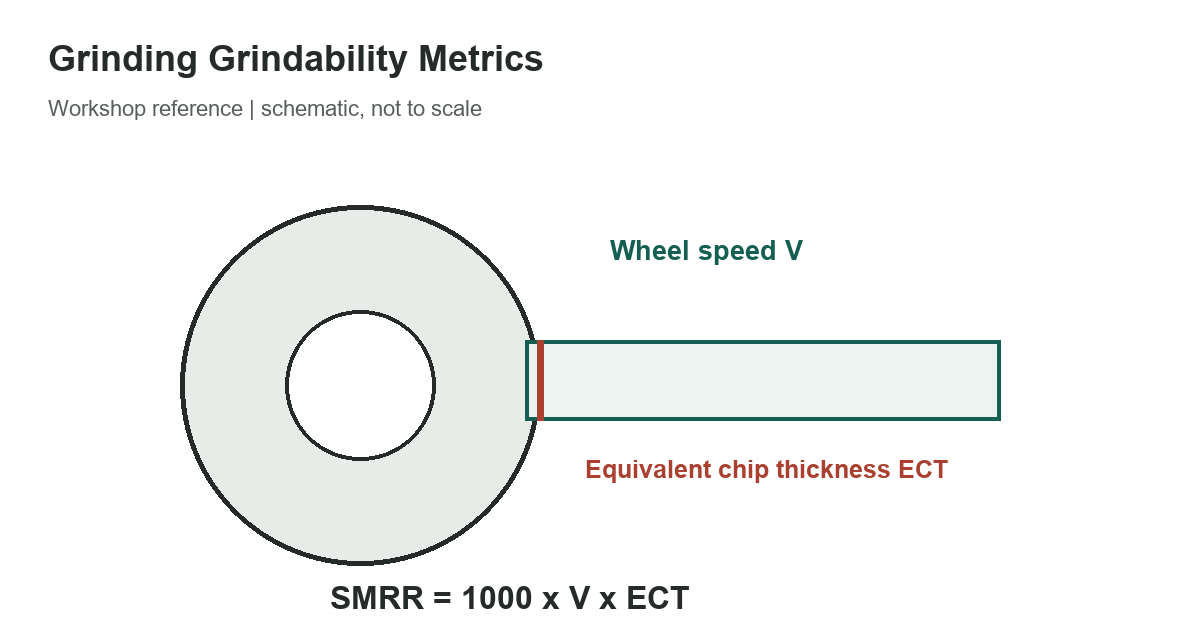
These examples use the relationship SMRR = 1000 x V x ECT, where V is wheel surface speed in meters per minute and ECT is equivalent chip thickness in millimeters. Here, 0.20 micrometer is converted to 0.00020 mm. The last column multiplies SMRR by an assumed 20 mm wheel width to show the resulting total rate in this simplified model.
[gs_table id=”10958″]
Follow the units through the equation
At 2,400 m/min and ECT of 0.00020 mm, SMRR = 1000 x 2,400 x 0.00020 = 480 mm3 per millimeter of wheel width per minute. At a 20 mm width, the calculated rate is 480 x 20 = 9,600 mm3/min. This is a dimensional calculation from the stated inputs, not a prediction that a particular grinder and wheel can sustain that removal rate.
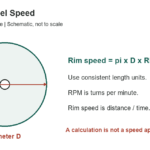
If wheel speed is supplied in meters per second, convert it before using this form: multiply m/s by 60 to obtain m/min. Keep ECT in millimeters. Converting micrometers to millimeters requires dividing by 1,000. Mixing units can change the result by factors of 60 or 1,000, so write each unit beside its value and check the final dimensions before comparing examples.
What the metric can and cannot tell you
SMRR is useful for expressing removal per wheel width. ECT is a process quantity rather than a fixed grade or hardness value for the workpiece. If the work material, wheel specification, feed, infeed, contact arc or machine changes, the resulting ECT and wheel behavior may also change. Values drawn from different operations should not be compared without checking how they were measured and what conditions were held constant.
Use the metric to compare trials only when the measurement basis is consistent. Record the removed volume, elapsed grinding time, wheel width, speed and process conditions, then state how ECT was established. A calculated value based on estimated inputs is not equivalent to a measured production result. If the wheel is dressed or changed during the trial, document that event because it can affect the observed rate and wheel wear.
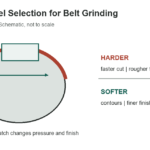
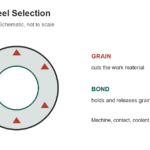
A material-group table is not a substitute for wheel-maker selection guidance. Norton describes abrasive choices that differ by material: aluminum oxide is commonly recommended for higher-tensile steels, while silicon carbide is used for some softer metals and nonmetallic materials. Those are starting points, not a prescription for every alloy or grinding operation. The same metal can respond differently depending on heat treatment, hardness, geometry and required finish.
Select the process as a system
Identify the exact material and hardness, the stock to remove, required geometry and surface finish, machine power and rigidity, wheel specification, contact area, wet or dry method, dressing method, and the wheel’s maximum operating speed. Norton emphasizes that wheel selection depends on several of these factors together. Verify that the wheel is rated for the machine and never exceed the maximum speed printed on the wheel.
Start with the wheel manufacturer’s application data and the machine manual. Make controlled trials only when the process allows it, and monitor power, vibration, heat, finish, wheel wear and workpiece condition. Stop if the wheel chatters, vibrates, loads, cracks or behaves unexpectedly. Do not compensate for a poor setup by increasing speed or feed beyond the rated limit.
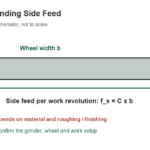
For related guides, see our grinding-wheel speed calculations, grinding-wheel selection guide, and cylindrical grinding side-feed examples. Those topics cover different process variables; none makes the calculated example a machine setting.
Sources
Norton’s grinding metrics guide defines specific material-removal rate per unit wheel width and presents a Q-prime relationship. Its wheel-selection guidance discusses material, grit, grade, contact area, process and speed limits. The worked values above use stated example inputs and independently recalculated arithmetic.