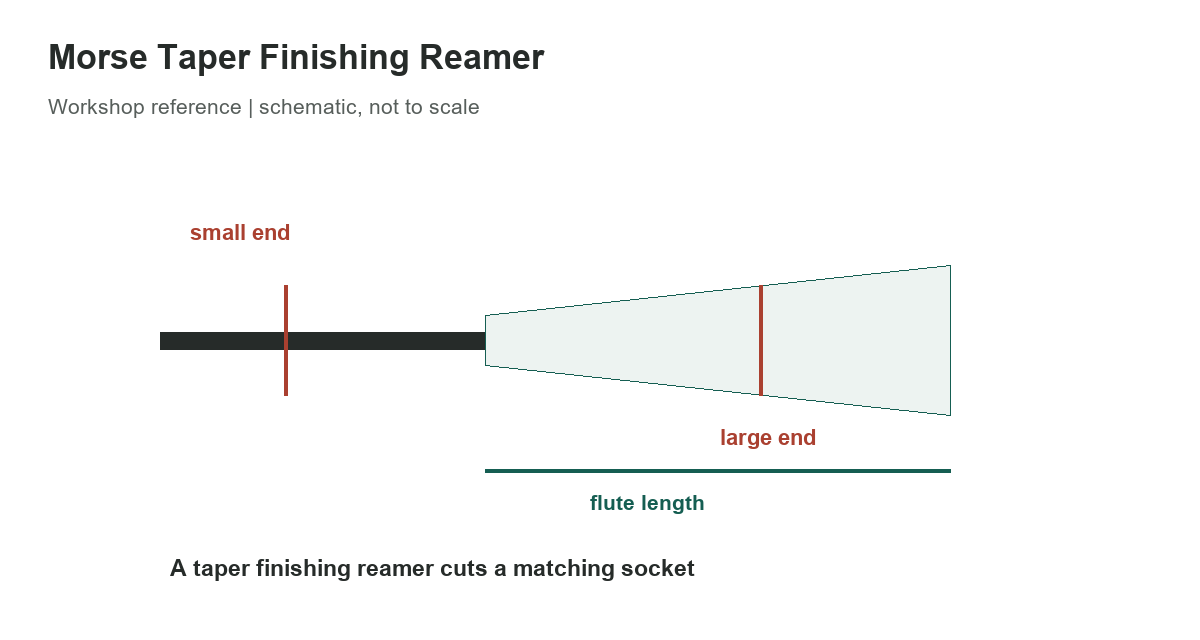
A Morse taper finishing reamer cuts or refines a Morse-tapered socket in a workpiece. It is not the same thing as a reamer whose own shank is Morse taper. Keeping the cutting tool and the resulting socket separate prevents a common fitment mix-up when identifying machine tooling.
Selected hand-style sizes
The table lists the nominal Morse taper size, Garvin catalog number, small-end and large-end reference diameters, flute length, and overall length for selected straight-flute hand-style reamers. All dimensions are inches. The entries come from the manufacturer’s current product page and cover sizes 0 MT through 5 MT. They are product dimensions, not finished-hole tolerances or a promise that every size is in stock.
For example, the listed 2 MT hand-style model has a small-end diameter of 0.5696 in, a large-end diameter of 0.7444 in, a 3-1/2 in flute, and a 6 in overall length. A similarly sized machine-style model has a different overall length. Do not mix hand and machine styles when comparing reach or planning tool clearance.
[gs_table id=”11109″]
Plan the cut and the fit
Before selecting a reamer, identify the exact taper number, the workpiece material, the existing hole, and the required finished fit. The manufacturer describes these tools for final sizing or finishing of Morse-tapered holes. A reamer removes a controlled amount of material; it is not a substitute for drilling or boring the hole close to the required size first. Follow the toolmaker’s cutting data and the machine’s operating instructions.
Check that the pilot hole, tool style, flute length, and machine travel allow the full intended cutting length to engage without the reamer bottoming in the work. Use appropriate cutting fluid for the work material and tool recommendations. Avoid reversing a cutting reamer while it remains engaged unless the manufacturer’s instructions explicitly allow it. Inspect the socket with the specified gauge or mating tool rather than judging the fit by appearance.
The taper-shank jobber reamer guide covers a different product, where the tool shank carries a taper. For straight-shank alternatives, see the straight-shank chucking reamer dimensions and letter-size chucking reamer reference. The drill-bit size chart helps with the preceding hole size, but a drill bit does not create the final Morse taper.
Use the catalog data carefully
Reference diameters help identify a model, but they do not define the taper angle, allowable runout, surface finish, or gauge tolerance. The product page identifies the series as ANSI B94.2 and gives both hand and machine styles. Confirm the exact catalog item and drawing before ordering, particularly when the tool must reach a shoulder or fit a restricted space.
Use a Morse taper gauge or an approved mating reference to inspect the finished socket. A shaft that appears to enter the socket is not proof of proper contact. Check the contact pattern, axial seating, and retention method specified for the machine. Do not lap, grind, or force a socket to make an incorrect taper fit.
Plan the setup so the reamer is aligned with the bore before it begins cutting. A tilted start can produce a socket that is not coaxial with the workpiece, even when the taper diameter appears close. Secure the part, use the feed method recommended for the tool, and stop if the reamer chatters, binds, or produces an uneven surface. Inspect the tool for chipped edges before returning it to service.
This selection is limited to six hand-style models. It does not cover spiral-flute tools, taper-shank reamers, tool steel grades, cutting speeds, allowances, or a universal finishing tolerance. The machine-tool drawing and current reamer instructions control the operation.
References
- Garvin Tools’ product page lists the selected catalog numbers, dimensions, and separate hand and machine overall lengths.
- ASME B94.2 covers reamer nomenclature, types, sizes, and tolerances; the standard is on stabilized maintenance.