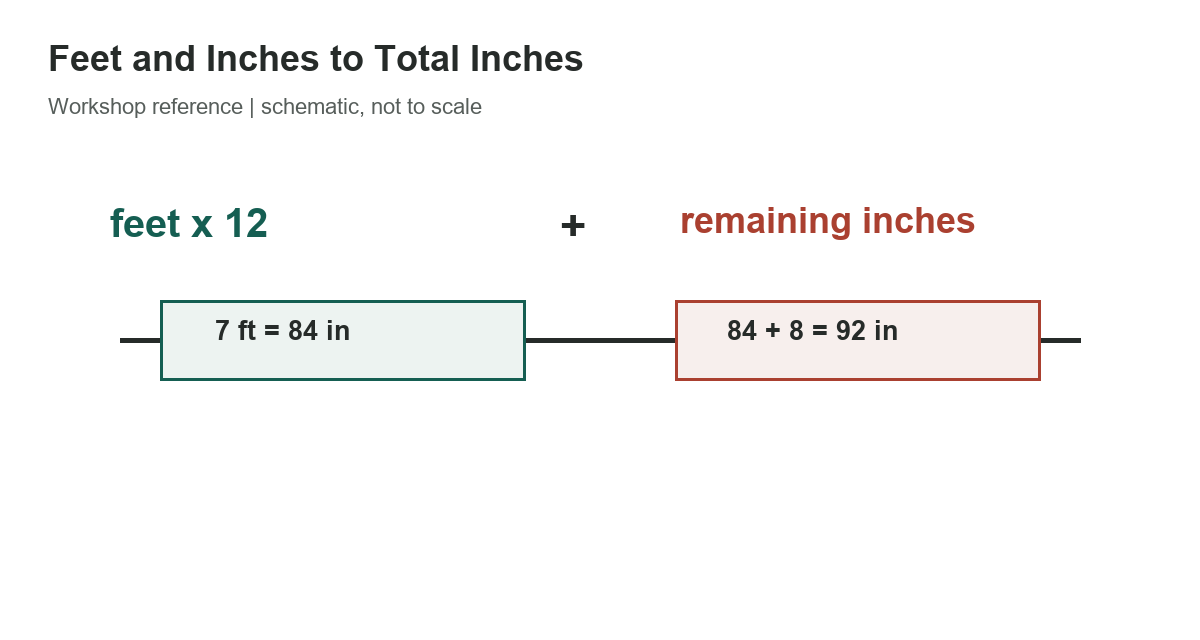
To convert a measurement written in feet and inches into total inches, multiply the feet by 12 and add the remaining inches. The chart gives selected examples; it does not convert to metric, and the rows are individual measurements rather than values to sum.
Feet-and-inches conversion chart
Use the total-inches column for a single length such as 7 ft 8 in. The arithmetic is 7 x 12 + 8 = 92 in. Use the table’s row that matches both the feet and additional inches; do not read across to a neighboring row or treat the inch portion as a decimal fraction of a foot.
[gs_table id=”10987″]
Conversion formula
The relationship is exact for the international foot: 1 ft = 12 in. For a measurement written as F feet and I inches, total inches = 12F + I. For example, 5 ft 6 in becomes (5 x 12) + 6 = 66 in. A length of 0 ft 11 in is 11 in, while 1 ft 0 in is 12 in.
The inch is exactly 25.4 millimeters, and the international foot is exactly 0.3048 meter. This chart intentionally stops at inches; if a drawing or tool uses metric, perform the separate unit conversion after combining the feet and inches. Do not multiply a feet value by the inch-to-millimeter factor without first expressing it in inches.
Keep feet and inches in the correct columns
In a tape reading, the feet value is the whole-foot mark and the inches value is the additional distance beyond that mark. A reading of 7 ft 8 in is not 7.8 feet and it is not 120 inches. It equals 92 inches. The number 120 inches is 10 feet, and if you add the separate 92-inch measurement to 120 inches, the total is 212 inches. Those are different operations.
When adding several mixed-unit measurements, convert each one to total inches first, add the inch values, then convert back if a feet-and-inches result is wanted. For example, 4 ft 9 in is 57 in and 3 ft 7 in is 43 in; 57 + 43 = 100 in, which is 8 ft 4 in. Keeping the intermediate unit visible reduces carry and place-value errors.
Fractions and measurement precision
For fractional inches, convert the fraction to a decimal or preserve it as a fraction during the arithmetic. A quarter inch is 0.25 in, so 6 ft 1/4 in = 72.25 in. Fractions such as 1/16 or 1/32 are often easier to keep exact until the final result. Round only to the precision needed by the measuring tool or drawing.
A mathematically exact conversion does not remove uncertainty in the measurement. If a tape reading is only accurate to the nearest eighth inch, reporting the converted result to six decimal places is misleading. Match the precision of the output to the input and the application. For a close fit, measure the actual part with an appropriate tool rather than relying on a nominal length.
Common uses and limits
This conversion is useful for lumber, room dimensions, vehicle clearances and other lengths written in customary units. It only changes the unit representation; it does not account for saw kerf, material shrinkage, installation gaps, tolerances or thermal expansion. Add those factors separately when they apply.
If a project document uses U.S. survey feet, do not substitute the international foot for surveying or geospatial work. NIST notes that the U.S. survey foot was retired for new use after 2022, but legacy data can still exist. The standard workshop feet-and-inches chart here uses the international foot defined as exactly 12 international inches.
Quick check
Estimate first: 7 feet is 84 inches, so a measurement with 8 additional inches should be slightly above 84. The result is 92 inches. If the calculated answer is 120 inches, check whether a separate 10-foot length was accidentally mixed into the calculation. A quick magnitude check catches this common mistake before it reaches a cut list.
Related references: exact inch-to-metric length relationships, rose chucking reamer dimensions, and ribbed-neck bolt dimensions. Each covers a separate shop-reference task.
Source and method
The exact inch definition is documented by NIST and conversion-factor guidance appears in NIST SP 811. The chart values were calculated as 12 x feet + additional inches. The original handbook example’s separate sum is retained in its proper meaning: 120 in plus 92 in equals 212 in.