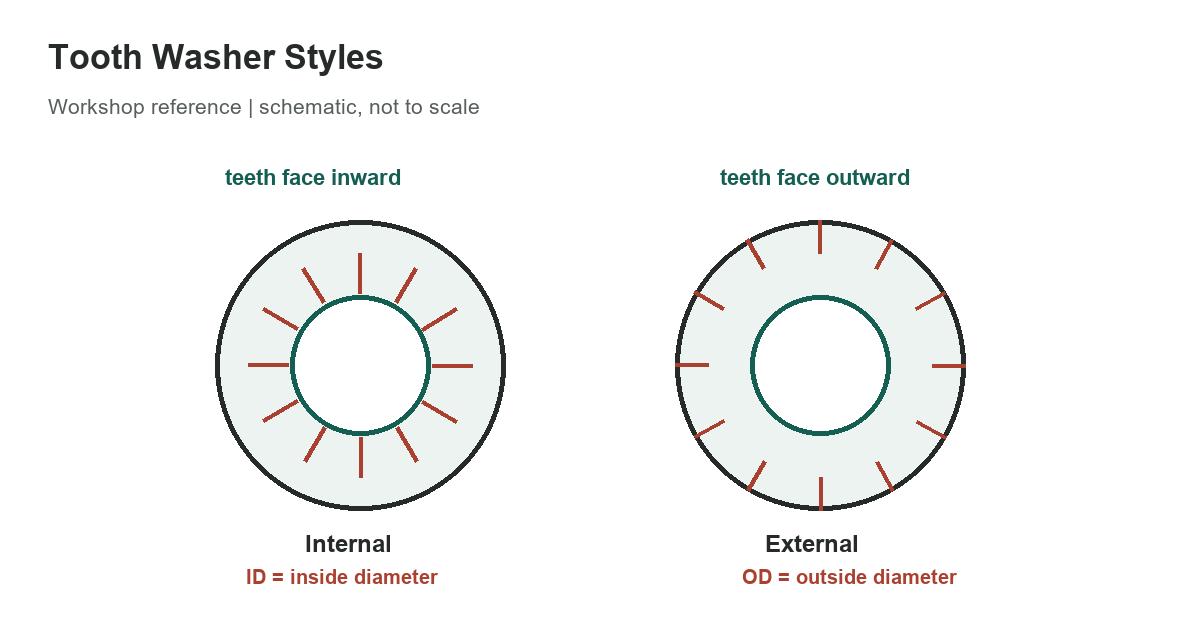
Tooth-lock washers differ by the direction of their teeth. An internal-tooth washer has teeth toward the center opening; an external-tooth washer has teeth around the outside edge; an internal/external washer combines both patterns. The selected chart compares representative inch-series dimensions for these three styles. A shared nominal fastener size does not make the styles interchangeable.
Compare the dimensions
The table shows inside diameter, outside diameter, and thickness as manufacturer-listed ranges in inches. It includes No. 4 and No. 8 machine-screw sizes plus 1/4- and 3/8-inch nominal sizes. For a No. 8 washer, for example, the selected internal-tooth product has an outside-diameter range of 0.325 to 0.340 in; the external-tooth product is 0.365 to 0.381 in; the combined style is 0.494 to 0.506 in. The outside dimension is strongly affected by the tooth pattern.
[gs_table id=”11113″]
Choose by the joint geometry
Internal teeth can fit beneath a smaller head or within a restricted outer envelope, while external teeth extend farther from the fastener. A combined-tooth washer projects in both directions. Those descriptions help identify shape; they do not establish a universal holding force or guarantee that the joint will resist loosening. Check the drawing, bearing surface, material, coating, and installation requirements for the actual assembly.
Measure the available clearance around the head or nut and compare it with the selected outside diameter. Check that the inside opening clears the fastener without excessive looseness and that the washer bears on the intended surface. A washer that fits the thread but overlaps a nearby shoulder, slot, coating, or curved surface may not seat correctly. Use the exact product series specified by the design.
For related styles, the high-collar helical washer chart and regular-section helical washer chart cover split spring-lock washers, not tooth-lock washers. The bolt and screw clearance chart addresses hole clearance and should not be used as a washer-diameter specification.
Standards and limitations
ASME B18.21.1-2009 (R2016) covers inch-series tooth-lock washers along with helical spring-lock and plain washers. ASME notes that inclusion of a dimension does not imply that every item is a stock product. The standard also says the word “lock” is historical and is not a promise of permanent fixity. Treat the size chart as a dimensional reference, not proof of performance.
Supplier listings can vary in coverage and product offering. The numbers here are selected Packer Fastener values associated with ASME B18.21.1; confirm the current catalog drawing, material, and thickness before ordering. If a joint is safety-critical, subject to vibration, or repeatedly loosens, follow the engineering specification and investigate the joint rather than relying on a washer name alone.
When comparing a replacement, use the inside and outside diameter ranges together. The inside diameter must clear the fastener shank; the outside diameter must fit the available bearing surface and surrounding clearance. Thickness affects stack height and may matter in a constrained joint. Do not use the washer’s tooth points to bridge a gap, compensate for a poor seat, or protect a soft surface unless the design specifically permits that contact.
Consider the surface under the head or nut as well as the washer envelope. Teeth may mark or bite into a mating surface, so the finish, coating, and hardness can matter to the assembly. If the design requires a broad smooth bearing face, a toothed style may be unsuitable even when its nominal size matches. Check the fastener manufacturer’s recommendations and the drawing before substituting one tooth pattern for another.
Do not substitute an internal, external, or combination-tooth washer for a specified locking method without approval. The table does not include all sizes, materials, coatings, or countersunk styles and does not provide torque, load, fatigue, or vibration data.
References
- ASME B18.21.1 states the standard’s scope and cautions about stock availability and the historical use of “lock.”
- Packer Fastener’s tooth-washer guide distinguishes tooth direction and lists the selected dimensions.