
The best car lift for a low-ceiling garage is the one that fits the measured clear height, vehicle, lifting points, floor, and intended work. A “low-ceiling” label does not prove that a lift works in an 8-foot garage. Add the vehicle height, the required lift height, adapters, door tracks, lights, and other overhead obstructions before choosing a model.
For most garages with limited height, the first options to compare are a portable low-rise lift such as QuickJack, a portable two-post lift such as the MaxJax M7K, or a floorplate two-post lift when the ceiling is high enough for its columns. QuickJack gives less underbody height but avoids tall columns. MaxJax gives more two-post access but still needs a substantial concrete and anchor plan. A conventional two-post lift can fit a lower ceiling only when its actual overall height and the vehicle’s needed lift height fit with clearance.
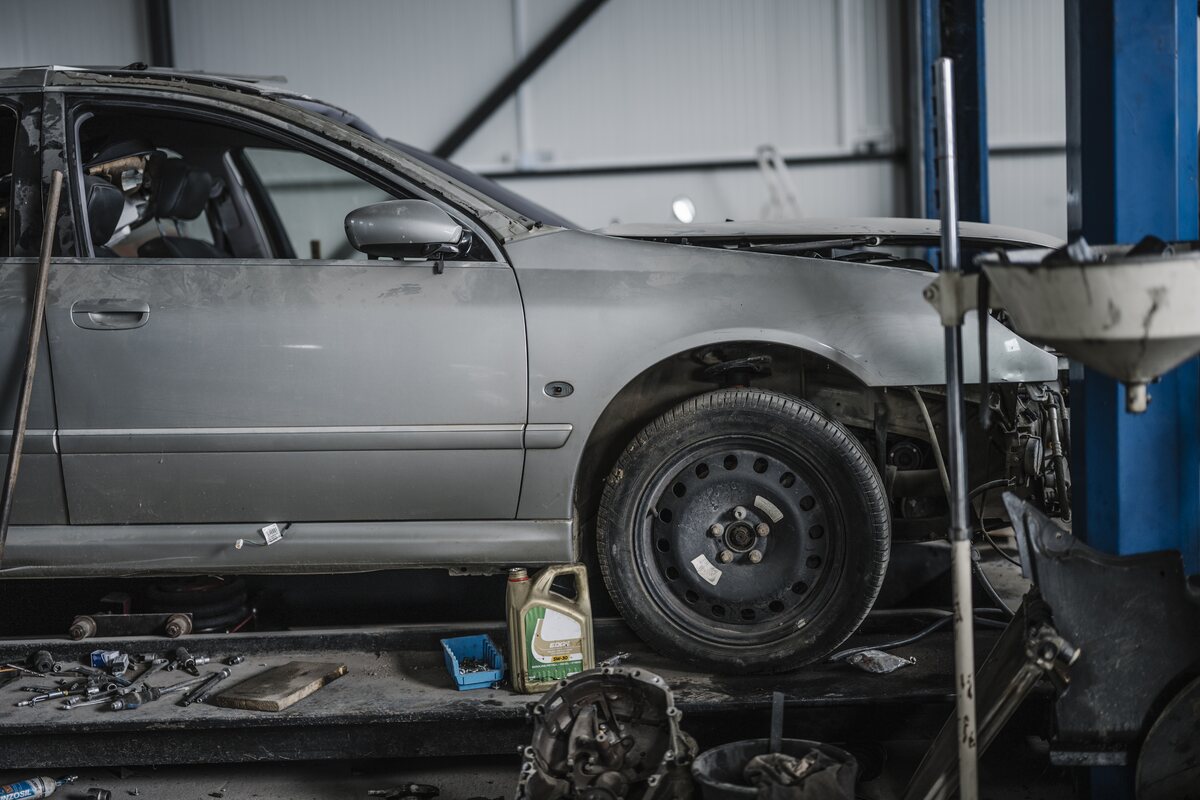
Vehicle lift photograph by Shixart1985, Wikimedia Commons, CC BY 2.0; reused as a general low-ceiling lift reference.
Quick picks by ceiling and use case
- Very low ceiling or shared garage: Start with a portable low-rise system. QuickJack TL models lift a vehicle roughly 20–24 inches depending on model and blocks, but they do not provide the same wheel-free access or standing room as a two-post lift.
- Around 8 feet with service access: Compare the MaxJax M7K. Its current specifications list an 89.5-inch overall height and a 47.25-inch maximum lifting height with pads. It needs a model-specific anchor and concrete plan, and the vehicle still must fit below the ceiling with the intended lifting height.
- Around 9 feet: A low-profile floorplate two-post may be possible only after checking its actual overall height, drive-through clearance, vehicle roof height, and door-track position. The current BendPak 9APF is 123 inches at the post, so it is not a 9-foot-ceiling solution even though its open-top layout removes an overhead crossbar.
- Around 10 feet or more: A compact two-post option may become practical, but compare the vehicle roof, door tracks, opener rail, and maximum lift height. Do not use the ceiling number alone.
The safest shortlist is the one that starts with measurements and removes models that cannot physically fit. Capacity, price, and wheel-off access come after clearance and foundation requirements.
Measure the garage before comparing lifts
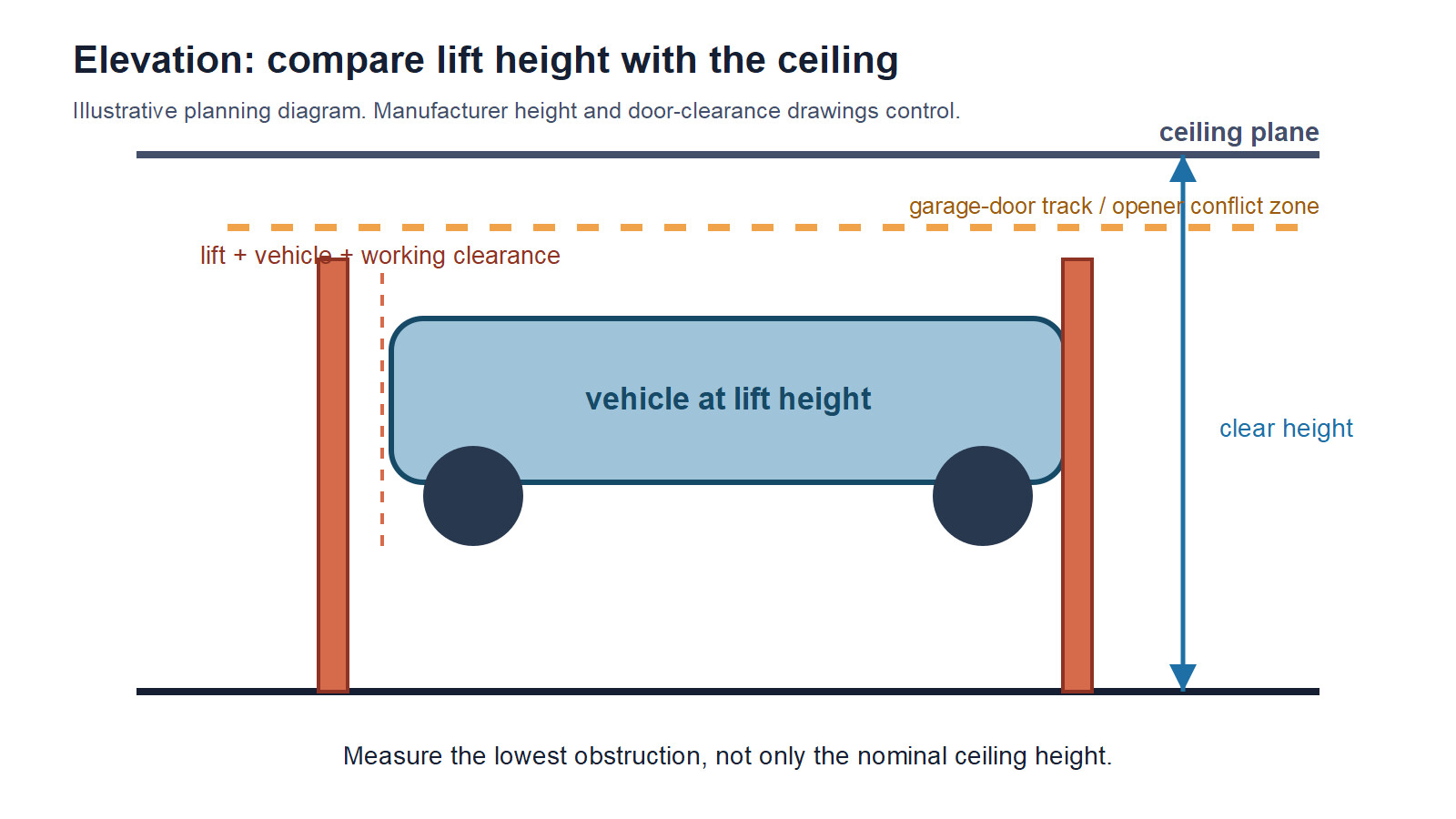
Measure the clear height from the finished floor to the lowest obstruction, not only to the ceiling drywall. Check the full bay under the garage door in both the closed and open positions. Record the lowest point of the door tracks, torsion-spring hardware, opener rail, lights, ductwork, storage, beams, and any temporary obstruction.
Measure the vehicle at its highest fixed point. Include roof racks, antennas, bed caps, cab lights, open hatch or trunk movement, and suspension height. If you will lift with the doors open, include the open-door envelope. If the vehicle has an adjustable suspension, use the condition in which it will enter and leave the lift.
Then write the clearance equation:
available lift height = clear overhead height − vehicle height − required safety clearance
The result must exceed the lift height needed for the job, including adapter height and the lift’s specified pad or frame measurement. For a low-rise lift, the limiting dimension may be the vehicle’s underbody access rather than the roof. For a two-post lift, the limiting dimension may be the roof, column, top bar, door track, or hydraulic cylinder.
Current low-ceiling comparison
The specifications below are current reference points. They are not guarantees that a particular vehicle can be lifted in a particular garage. Confirm the exact model, accessories, power unit, foundation, and manual before purchase.
| Lift option | Type | Rated capacity | Overall/column height | Maximum lift height | Minimum pad or lowered height | Electrical supply | Slab/anchor requirement | ALI certification status | Best use | Biggest limitation |
|---|---|---|---|---|---|---|---|---|---|---|
| QuickJack 5000TL | Portable low-rise frame lift | 5,000 lb | No tall column; frame system | 24 in with current comparison specs | 3 in | Choose current 110V AC or 12V DC power unit | Use the current QuickJack manual, correct blocks, level surface, and clear lift points; no permanent two-post anchors | Verify local requirements; do not assume ALI certification | Sedans, sports cars, brake, tire, and underbody service | Limited standing room and wheel-free geometry depends on the frame and vehicle |
| QuickJack 7000TL / 7000TLX | Portable low-rise frame lift | 7,000 lb | No tall column; frame system | 24.5 in with current comparison specs | 3.5 in | Current power-unit options include 110V AC or 12V DC | Follow the current manual and vehicle-specific block/adapter requirements | Verify local requirements; do not assume ALI certification | Trucks, SUVs, and longer wheelbases when spread and adapters match | Still a low-rise lift; maximum height is much lower than a two-post lift |
| BendPak MaxJax M7K | Portable two-post | 7,000 lb | 89.5 in | 47.25 in with pad in current product specs | 5.5 in with pad | 110V, 50/60 Hz, single phase | Manufacturer-specific anchors and foundation requirements; current BendPak foundation guidance lists new-concrete requirements for M7K | Check the current ALI directory for the exact M7K model; certification is model-specific | Home garages needing portable two-post access near an 8-foot ceiling | Requires careful anchor placement, vehicle balance, and column storage space |
| BendPak 9APF | Current open-top floorplate two-post | 9,000 lb | 123 in post height | 73.5 in with pad in current sales specifications | 4.5 in with pad | 208–240 VAC, 50/60 Hz, single phase | Use the current 9APF manual and BendPak concrete guidance; cracks, joints, edge distance, and post-tension risks still apply | Verify the exact model in the ALI directory; BendPak says certification varies by model | Low-ceiling shops that need full two-post access without an overhead beam | Too tall for a 9-foot ceiling and still requires substantial slab and electrical planning |
The table separates frame height from lift height because they solve different problems. A QuickJack frame can fit under a low vehicle and remain below the ceiling, but it cannot raise the vehicle to standing working height. MaxJax has a low overall height but still needs room for the vehicle, adapters, columns, arms, and overhead obstructions. The 9APF demonstrates why an open-top or “low-ceiling” two-post label does not equal compatibility with every low garage.
Portable low-rise lifts
QuickJack TL systems place two portable frames at the vehicle’s lift points. Current comparison material lists a 3-inch lowered height and up to 24 inches of lift for the 5000TL, and a 3.5-inch lowered height and up to 24.5 inches for the 7000TL and 7000TLX. The 7000TLX adds length for longer wheelbases, but a longer frame does not automatically fit every truck or SUV.
Low-rise frames are useful for tire changes, brake work, exhaust work, oil service, and many underbody inspections. They are less useful when you need the wheels hanging free, a person standing below the vehicle, or unrestricted access to the centre of the chassis. Confirm the lift-point spread and block height for the vehicle. A capacity rating does not correct a jack-point mismatch.
The power unit can be selected in different electrical configurations. Choose the current option that matches the garage and follow the manual for hydraulic hose routing, fluid, synchronized lifting, mechanical locks, and lowering. Keep the frames on a level surface and inspect the contact points before lifting. Do not use improvised blocks or place the frame where a seam, drain, or damaged slab can change its support.
Portable two-post option: MaxJax M7K
The MaxJax M7K is designed for low-ceiling garages and current product specifications list a 7,000-pound capacity, 89.5-inch overall height, 47.25-inch maximum pad lift, and 110V single-phase power. Those dimensions make it a meaningful candidate for an 8-foot garage, but they do not make every 8-foot garage suitable.
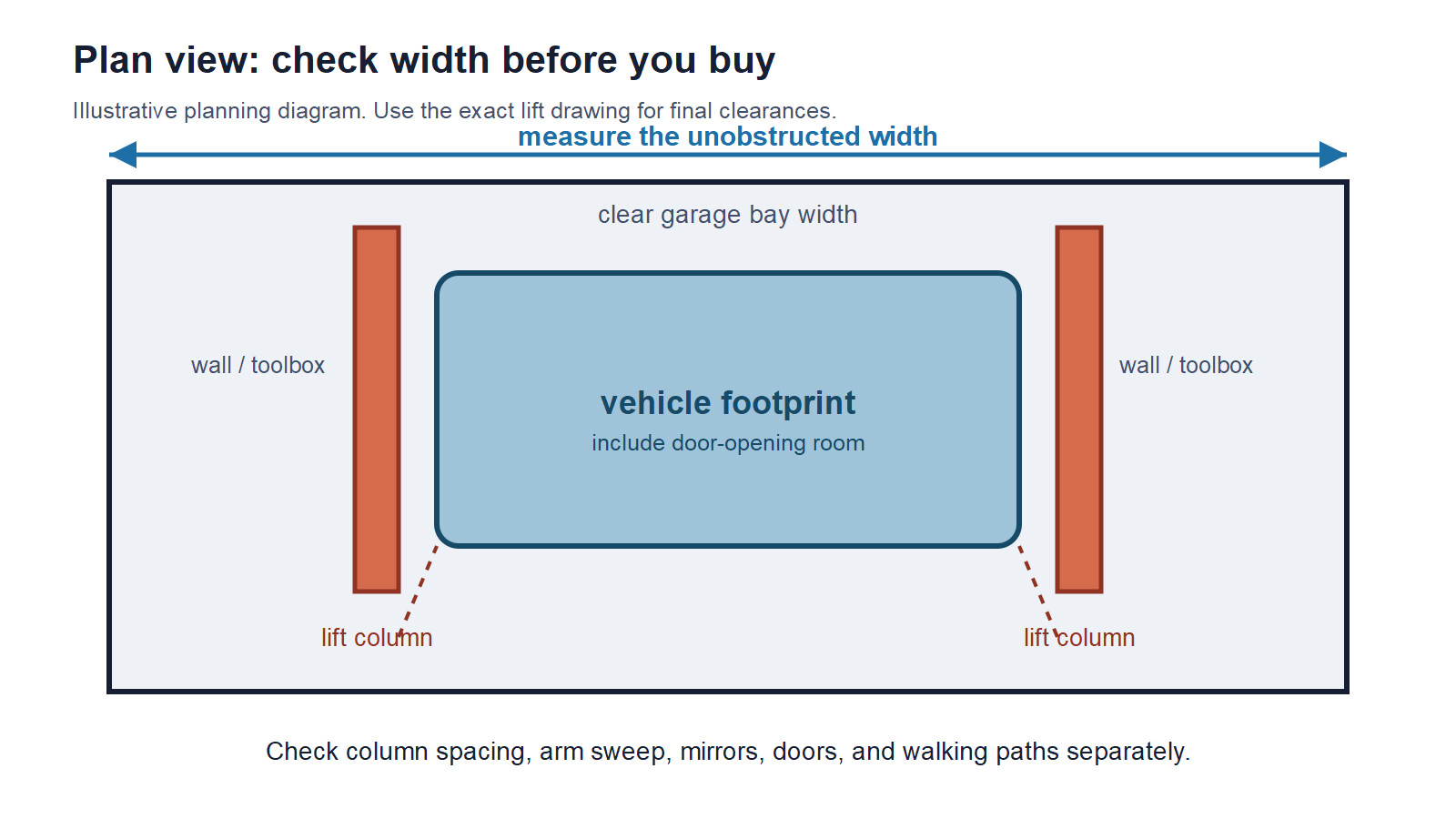
The vehicle’s roof must remain below the lowest obstruction throughout the lift. The doors, roof rack, exhaust, and suspension must clear the columns and arms. The columns need enough working and storage space, and the posts must be placed on the manufacturer-approved anchor pattern. The current BendPak foundation guidance lists significant requirements for new concrete, including slab thickness, width, length, reinforcement, anchor diameter, and anchor length. Treat this as a structural installation, not a portable jack stand.
Before selecting M7K, confirm the exact lift model in the ALI directory and check the local authority, insurer, and building requirements. The ALI directory is model-specific. A manufacturer page or a different MaxJax model cannot prove certification for M7K.
Open-top floorplate two-post option: BendPak 9APF
A floorplate two-post lift can help where a clear-floor overhead crossbar would interfere with a low ceiling, but the columns and arm geometry still require room. The current BendPak 9APF product page lists a 123-inch post height, 9,000-pound capacity, 73.5-inch maximum lifting height with pad, 4.5-inch minimum pad height, and 208–240V single-phase power.
At 8 feet, 123 inches cannot fit. At 9 feet, it still exceeds 108 inches before accounting for practical clearance. At 10 feet, the post may fit, but the vehicle roof, door tracks, opener, and lift height still need a scaled check. This example is useful because an open-top floorplate layout may solve one overhead-crossbar problem while leaving the overall height too large.
Do not reduce the lift’s maximum travel or change the safety stop to fit a garage. If the model geometry does not work, choose a different lift or a professional design. Never cut a column, remove a lock, shorten an arm, or modify a crossbar.
8-foot garage example
An 8-foot ceiling provides 96 inches before any beam, track, opener rail, light, or clearance margin is subtracted. A 72-inch vehicle leaves only 24 inches in a simplified calculation. A 2-inch roof rack and the need for several inches of safe clearance reduce the usable lift height further.
A QuickJack-style lift may fit the space because its maximum lift is about 24 inches, but the working height may be limited. MaxJax M7K may fit by overall column height, but the vehicle and obstruction envelope must be checked at the desired pad height. A BendPak 9APF does not fit by its 123-inch post height.
Do not treat this example as a universal calculation. Measure the vehicle and obstruction height, then compare the exact model drawing and manual.
9-foot garage example
A 9-foot ceiling provides 108 inches before deductions. A two-post model with a 123-inch post height fails the basic column-height check, even if the door is open. A MaxJax-style portable two-post may fit by column height, but its maximum pad lift and vehicle roof clearance still need checking. A QuickJack may fit physically but may not provide the wheel-free access the job requires.
At this height, inspect the garage door tracks and opener rail carefully. A door in the open position can occupy the same vertical and horizontal space as the lift arms or vehicle roof. The lift may fit with the door closed but fail when the door is open, or vice versa.
10-foot and taller garage example
A 10-foot ceiling gives more flexibility, but do not jump directly to a full-height 2-post lift. Check overall height, top-bar or hydraulic-cylinder position, drive-through width, arm reach, the vehicle’s high point, and the required lifting height. A taller vehicle or a door track below the ceiling can still make a model unsuitable.
If the garage is intended for a truck, SUV, or vehicle with a roof rack, use the actual vehicle rather than a passenger-car assumption. If the intended work is wheel-off suspension or drivetrain service, confirm that the lift can reach that height while keeping the vehicle stable and the arms within their specified reach.
Garage-door and opener interference
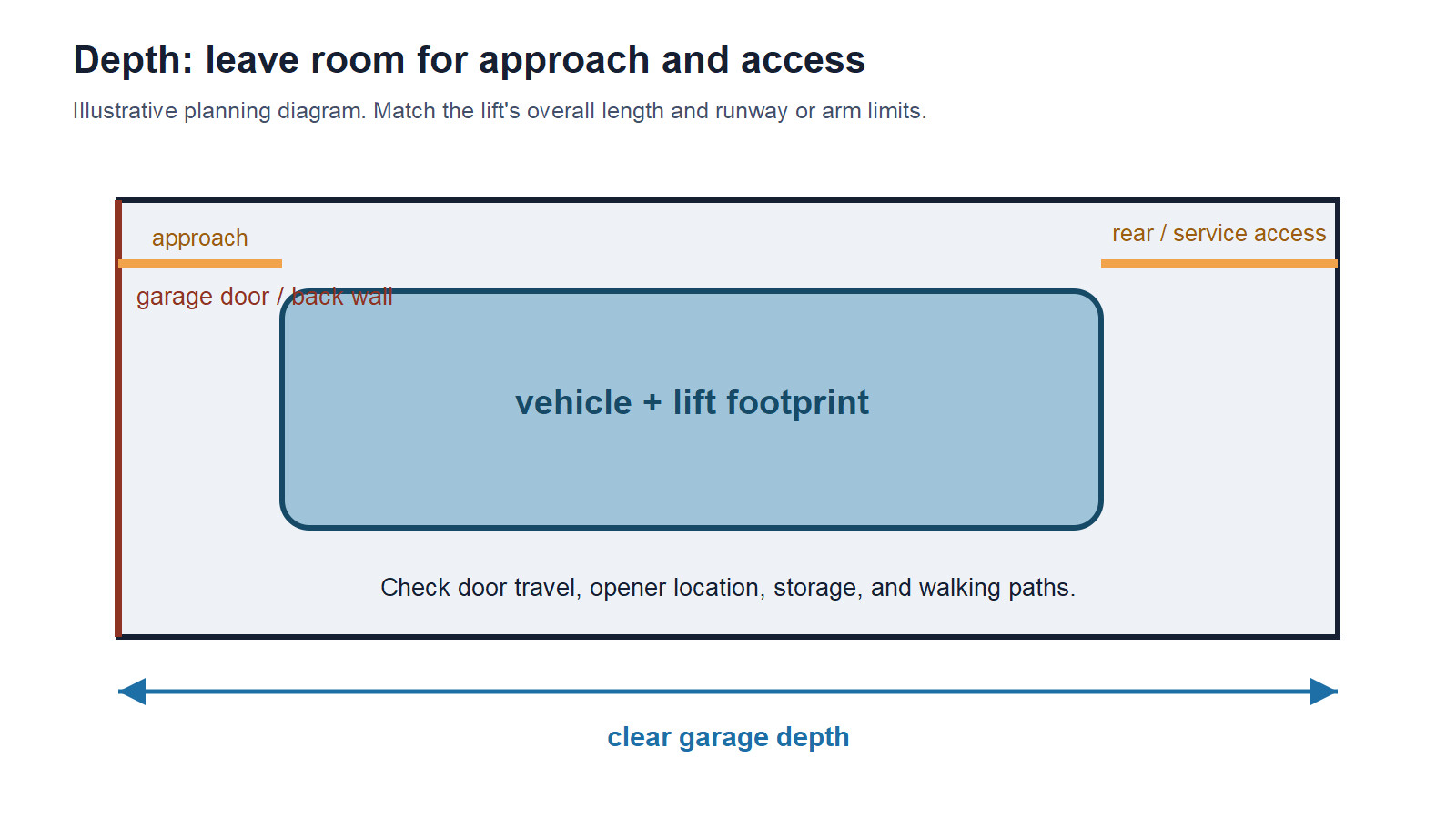
Measure the door in the open position. Track radius, horizontal tracks, torsion hardware, opener rails, and hanging motors can occupy the centre or sides of the bay. A portable lift that is stored after use may still need the door clear while the vehicle is raised.
Never move a door, track, spring, opener rail, or header to make a lift fit without a garage-door professional. Springs and cables store dangerous energy. If the lift layout conflicts with the door system, change the lift location or use a professional redesign.
Slab, anchors, and electrical requirements
Low ceiling does not reduce foundation requirements. QuickJack requires the correct frame placement, blocks, surface, and manual procedure. MaxJax and conventional two-post lifts transfer concentrated loads through anchors and require the manufacturer’s concrete and anchor specifications. A floor that is thick enough for one lift may not be acceptable for another.
Check for cracks, joints, edge distance, repairs, post-tension cables, radiant heat, and embedded services before drilling. Do not drill an unknown slab. For a new or questionable foundation, use the lift manual and a qualified concrete or structural professional.
Electrical requirements also vary. MaxJax M7K current specs list 110V single-phase power. QuickJack supports multiple power-unit options, including 110V AC and 12V DC. The BendPak 9APF sales sheet lists 208–240V single-phase power. Confirm voltage, circuit capacity, disconnect, and local code before purchase.
Wheel-off access tradeoffs
Low-rise frames are efficient for tires, brakes, and many underbody jobs, but the wheels may remain near the floor or the frame geometry may limit suspension access. Two-post lifts provide better wheel-off and underbody access but impose stricter requirements for balance, arm reach, adapter placement, anchors, and stability.
Choose the work first. If the main jobs are oil changes, tire rotations, brake work, and exhaust inspection, low-rise may be enough. If the work includes suspension, transmission, driveshaft, or full underbody repairs, compare two-post access and make sure the ceiling and slab can support it.
Final selection checklist
- Clear height measured to the lowest obstruction.
- Garage door measured in closed and open positions.
- Vehicle height recorded with racks, antennas, and accessories.
- Required lift height defined by the actual jobs.
- Lift type selected for wheel-off or low-rise access.
- Rated capacity exceeds the vehicle and its weight distribution.
- Pad, block, adapter, and lift-point geometry confirmed.
- Overall height and maximum lift height checked against a scaled bay layout.
- Slab thickness, strength, cracks, joints, reinforcement, and post-tension risk verified.
- Electrical supply and circuit requirements confirmed.
- Current ALI status checked for the exact model where applicable.
- Manual, warranty, replacement parts, and local inspection requirements reviewed.
For more planning context, use the car-lift ceiling-height guide, 2-post lift concrete requirements, 2-post versus 4-post comparison, and best car lifts for a home garage.
Sources and method notes
Current dimensions and requirements were checked against the BendPak MaxJax M7K product page, the MaxJax M7K installation manual, the BendPak 9APF product page, the 9APF sales sheet, BendPak concrete-floor guidance, QuickJack model comparison, and the ALI certified-lift directory. Product specifications and certification status can change. Verify the exact current manual and local requirements before ordering or installing a lift.